
From the Founder
By Grant Wootten, Founder & CEO, Edusfere
Most edtech AI tries to replace the teacher’s judgment; we do the opposite. The teacher in the room is the only one who knows that group of students, that moment, that context and they’re either drawing on years of instinct or actively building it; a chatbot that decides for them shortcuts both.
We use AI for what it’s good at: inference from context, under the teacher’s editorial control. Everyday practice becomes institutional knowledge instead of walking out the door.
AI can build a curriculum map. But can it build better learning?
AI is no longer an emerging trend in education. It is already reshaping how institutions teach, assess and manage learning. UNESCO notes that AI has the potential to transform teaching, learning, assessment and educational management, while also raising urgent questions around ethics, equity and governance. The pace of adoption is accelerating. In the UK, a 2025 Higher Education Policy Institute survey found that 92% of university students were using AI tools, up sharply from 66% the previous year. That tells us something important, i.e. the question is no longer whether AI belongs in education. It is already there.
The real challenge is how institutions and teachers use it wisely, especially in curriculum mapping, curriculum management and curriculum planning, where speed and scale matter but academic quality matters even more. Because curriculum design has never been just about efficiency.
A strong curriculum does more than organize topics or automate workflows. It shapes how students think, what they value, how they solve problems and how they progress over time. It connects learning outcomes, teaching strategies, assessments and graduate capabilities into one purposeful journey. That is why the real conversation is not AI vs humans. It is about how AI can be partnered best with human expertise.
How is AI Reshaping Curriculum Design ?
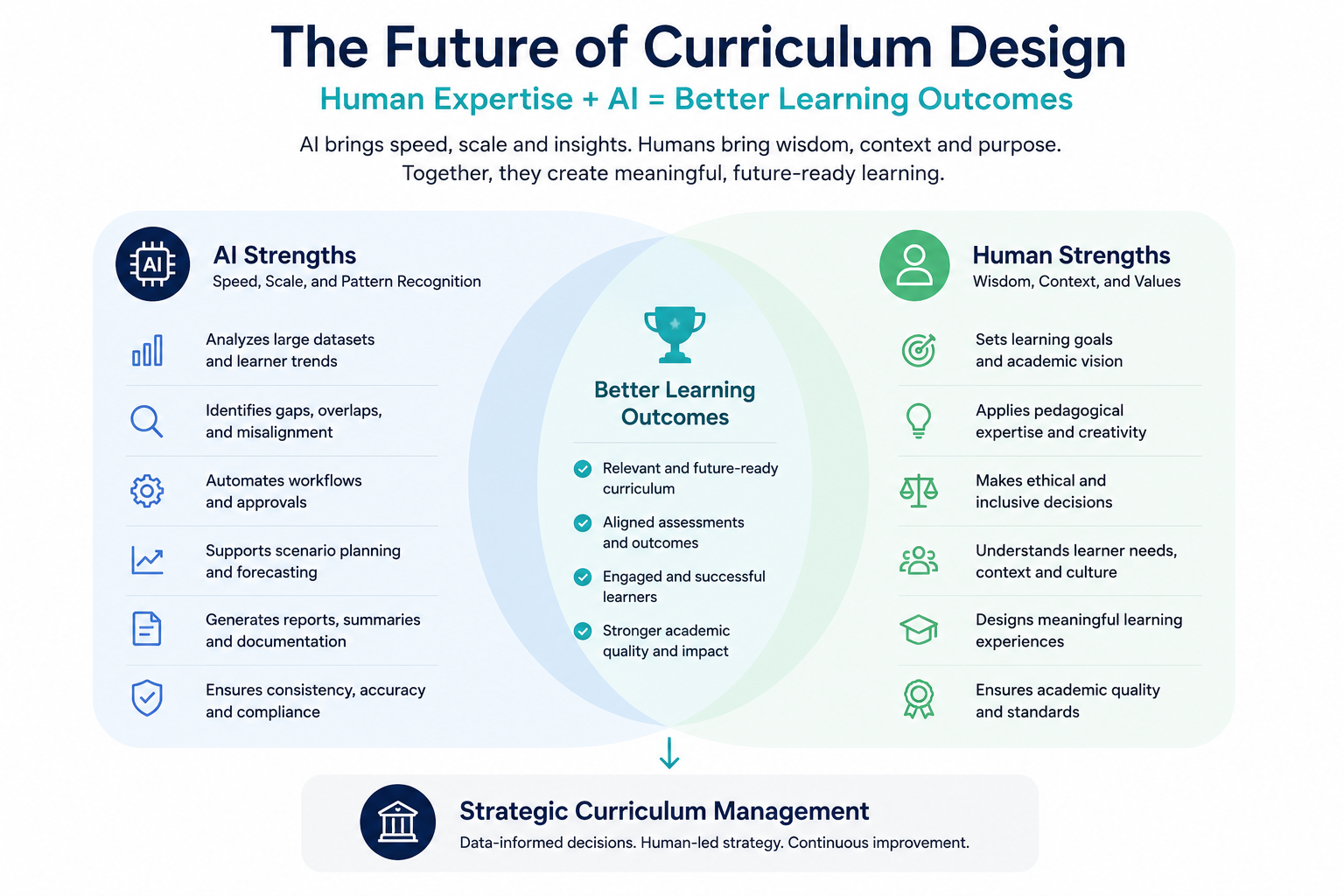
Across education, institutions are being asked to respond faster to changing workforce needs, learner expectations, accreditation requirements and digital transformation. Traditional curriculum review cycles often take months because they depend on disconnected spreadsheets, email approvals and manual audits. AI helps remove that friction.
While outcomes vary by institution, the direction is clear, i.e., used well, AI can improve responsiveness and learner success.
What AI Does Well
AI can be effective in high-volume, data-heavy tasks such as:
Detecting gaps in learning outcomes
One of the most common curriculum risks is not what is included but what is missing. Important graduate capabilities such as critical thinking, communication, digital literacy, sustainability or employability skills can be assumed rather than intentionally embedded. AI can scan curriculum documents and compare intended outcomes against institutional frameworks or accreditation standards. It highlights where required competencies are underrepresented or absent entirely.
That allows curriculum teams to close gaps proactively before they affect learner readiness or compliance outcomes.
Identifying duplicate or outdated content
As programs evolve over time, duplicate topics often appear across multiple subjects, especially when different departments update courses independently. Similarly, content can remain in place long after industry practice, regulations or technology have changed.
AI can identify repeated themes, overlapping modules and content that may no longer reflect current standards. Instead of reviewing every document manually, teams can quickly spot where curriculum space is being wasted or where modernization is overdue. In a nutshell, while AI systems can improve redundancies, the quality of the outcome is directly proportional to the expertise of the concerned teachers.
The result is a more relevant, efficient and future-ready curriculum.
Reviewing assessment alignment
Strong curriculum design depends on constructive alignment, i.e., assessments should measure the learning outcomes students are expected to achieve. However, in practice, many institutions discover mismatches such as low-level quizzes for high-level critical thinking outcomes or assessments repeated without clear progression. AI enabled workflow can compare assessment tasks, rubrics and stated outcomes to flag potential misalignment. It can identify whether assessment methods are varied enough, whether cognitive demand increases over time and whether evidence of learning matches program goals.
This supports more valid, transparent and learner-centred assessment design.
Analyzing learner performance trends
Curriculum quality should be informed by evidence, not assumptions. Patterns in learner performance can reveal where students consistently struggle, disengage or excel. But these insights are often buried in large volumes of academic data.
AI can analyze grades, completion rates, progression data, attendance signals, engagement patterns and feedback trends to surface meaningful insights. It may reveal that a specific module has unusually high failure rates, that one assessment format creates repeated barriers or that support interventions improve outcomes for certain cohorts.
This helps institutions make smarter curriculum improvements based on real learner experience.
Supporting scenario-based curriculum planning
Curriculum planning is increasingly shaped by uncertainty. Institutions must respond to changing workforce demands, new technologies, policy shifts and emerging student expectations. Planning only for the present can leave programs outdated quickly. AI can support scenario-based curriculum planning by modeling different possibilities.
For example, it can help institutions explore how demand for AI skills, sustainability capabilities, healthcare roles or flexible learning pathways may affect future programs.
Rather than relying solely on intuition, leaders can use data-informed scenarios to make more confident strategic decisions.
Automating approvals and documentation in curriculum management
Many curriculum teams spend significant time on administration rather than strategy. Approval workflows, version tracking, meeting papers, policy checks, audit evidence and document storage can slow progress and create confusion. AI can streamline these operational processes by routing approvals, summarizing proposed changes, flagging missing information, generating reports, maintaining version history and organizing documentation for reviews or accreditation. This reduces administrative burden, improves governance and allows academic leaders to focus on quality enhancement rather than paperwork.
This gives educators more time to focus on learning quality rather than administrative complexity.
Why does this matter?
When institutions use AI in these areas, the goal is not to replace educators. It is to remove friction, improve visibility and strengthen decision-making. That is where modern platforms such as Edusfere become valuable, right from helping institutions connect curriculum mapping, curriculum management and curriculum planning in one strategic live system built for continuous improvement.
Why Does Human Expertise Matter More Than Ever ?
Even advanced AI cannot fully understand the live reality of teaching and learning. It does not read classroom energy the way an educator does. It cannot notice hesitation before a student asks for help, redesign an activity in the moment or understand the emotional context behind disengagement. That human layer matters because education is relational, not just operational.
Global policy bodies such as UNESCO continue to emphasize a human-centred approach to AI in education, one that protects equity, inclusion and learner agency while using technology responsibly.
Human expertise remains essential for:
- Pedagogical design
- Ethical decision-making
- Inclusion and accessibility
- Cultural relevance
- Motivating learners
- Interdisciplinary thinking
- Academic standards interpretation
- Long-term curriculum vision
AI can generate options. Humans decide what is worth teaching and why.
5 Smart Ways to Balance AI and Human Curriculum Design
1. Let AI Analyze Data. Let Educators Define Learning Goals
Most institutions already sit on large volumes of curriculum data: outcomes, assessments, progression maps, student performance trends and review feedback. AI can process this information quickly and reveal patterns that would take teams weeks to uncover manually. But deciding what students should ultimately become is a human responsibility.
Questions like what kind of graduate are we developing, which capabilities matter most in our region or discipline require academic leadership, not algorithmic prediction.
Best Practice
Use AI to surface evidence. Let humans define purpose.
2. Use AI for Curriculum Mapping, Not Curriculum Quality
Curriculum mapping is one of the strongest use cases for AI because it is structured, repetitive and data-rich. Institutions can run faster alignment reviews and spend more time improving programs instead of manually cross-checking spreadsheets. AI can rapidly show:
- Where outcomes are introduced, reinforced and mastered
- Which standards are missing
- Where topics repeat unnecessarily
- Where assessments do not match learning goals
- Where progression between courses breaks down
But mapping alone does not guarantee meaningful learning. A perfectly aligned curriculum can still feel fragmented or overloaded if teaching design is weak.
Best Practice
Use AI for structure. Use educators for learning quality.
3. Automate Routine Curriculum Management; Keep Governance Human
Many institutions do not struggle with curriculum ideas, they struggle with administration. Version control, approvals, policy checks, audit trails and review deadlines often slow progress more than academic debate itself. This is where strategic platforms such as Edusfere create value.
Modern curriculum management should not rely on disconnected spreadsheets and scattered emails. Institutions need connected systems that improve visibility, reduce manual workload and create stronger governance. AI can help with:
- Tracking revisions
- Summarizing changes
- Flagging policy conflicts
- Managing workflows
- Generating reports
- Monitoring review deadlines
- Supporting accreditation readiness
Best Practice
Automate administration. But keep accountability human.
4. Build AI Literacy Into Curriculum Planning
The most forward-looking institutions are not only using AI to improve internal systems; they are redesigning curriculum planning so graduates can work effectively in an AI-shaped world. Schools, universities and employers increasingly expect learners to understand how AI tools work, where they add value and where human judgment remains essential.
Future-ready curricula should include:
- Prompting and collaboration with AI tools
- Critical evaluation of AI outputs
- Bias detection
- Ethical use of AI
- Privacy awareness
- Verification and source checking
- Responsible decision-making with AI assistance
Best Practice
Use AI to improve curriculum planning and teach students how to use AI responsibly.
What Do Education Institutions Commonly Struggle With?
Across the school, curriculum teams often face the same operational challenges:
- Multiple versions of curriculum documents
- Slow approval cycles
- Limited visibility across programs
- Weak curriculum mapping consistency
- Manual accreditation evidence gathering
- Difficulty updating curriculum quickly
- Siloed decision-making across departments
These are not just administrative frustrations. They directly affect agility, compliance and learner outcomes. This is why curriculum management is becoming a strategic priority, not just a back-office function.
AI vs Human Roles in Curriculum Design
Why Does This Approach Win?
Institutions that rely only on manual processes often struggle to keep pace with changing learner expectations, workforce demands and regulatory requirements. At the other extreme, institutions that over-rely on AI risk creating generic, overly standardized or poorly contextualized learning experiences. The real advantage lies in combining both. When automation handles repetitive analysis and operational complexity, educators gain more time to focus on pedagogy, learner success and strategic improvement. That balance enables institutions to move faster without compromising academic quality.
A well-executed human + AI model can deliver:
- Faster curriculum updates
- Stronger curriculum mapping
- Smarter curriculum management
- Better curriculum planning
- Lower administrative burden
- Higher academic quality
- Better student outcomes
- Greater agility in a changing market
This is more than an efficiency gain. It is a competitive advantage for institutions that want to stay relevant, responsive and future-ready.
Key Takeaways
- AI improves curriculum mapping by identifying gaps, overlaps and alignment issues quickly.
- Curriculum management becomes more efficient when AI automates workflows and reporting.
- Human educators remain essential for pedagogy, ethics and learner-centered design.
- The best model is AI + human expertise, not AI vs humans.
- Institutions need connected systems to operationalize curriculum strategy at scale.
FAQs about AI and Curriculum Design
1. Can AI replace curriculum designers?
No. AI can support analysis and automation. But educators provide pedagogy, context, ethics and strategic direction.
2. How does AI improve curriculum mapping?
AI helps identify gaps, duplication, misalignment, missing standards and progression issues across programs and courses.
3. What is AI’s role in curriculum management?
AI can streamline approvals, documentation, reporting, version control, review cycles and accreditation readiness.
4. How does AI support curriculum planning?
AI can analyze trends, learner data, skill demand and future scenarios to support better planning decisions.
5. What are the risks of AI in curriculum design?
Risks include bias, over-standardization, privacy concerns and overreliance on automated recommendations.
6. What is the best strategy for schools and universities?
Use AI for speed, scale and insight. Use educators for learning design, governance and student success.
7. What is curriculum mapping in higher education?
Curriculum mapping is the process of aligning courses, learning outcomes, assessments and standards across a program to ensure coherence and progression.
8. Why do schools need curriculum management software?
It helps institutions manage approvals, version control, collaboration, compliance, reviews and curriculum changes more efficiently.
The Future of Curriculum Starts Now
AI is not replacing curriculum expertise. It is raising the value of that expertise.
When automation handles repetitive work, educators gain more time to design meaningful learning, support students and build programs that stay relevant in a fast-changing world.
Edusfere helps institutions turn curriculum strategy into action with smarter curriculum mapping, streamlined curriculum management, faster review cycles, stronger governance and data-backed curriculum planning in one connected platform. Instead of managing curriculum through disconnected spreadsheets and manual workflows, academic teams can move faster, collaborate better and make confident decisions at scale.
If your institution is ready to modernize curriculum operations while keeping pedagogy at the center, Edusfere is built for that future.
Reviewed by:
Grant Wootten, Founder & CEO, Edusfere