

Artificial intelligence or AI is no longer a peripheral tool in education. It is steadily moving into the core of how schools design, deliver and evaluate learning. What began as support for grading or content generation is now influencing curriculum planning, curriculum mapping and curriculum management at a systemic level. This shift raises an important question for district leaders, principals and curriculum directors, i.e, can AI design a school curriculum and if it can, should it?
The urgency of this question is backed by data. Recent studies indicate that over 80% of educators in the United States are already using AI tools in some capacity, while UNESCO reports that fewer than 10% of institutions have formal policies governing AI use. At the same time, accreditation bodies such as Cognia and ACSI continue to emphasize alignment, continuous improvement and measurable learning outcomes. This creates a unique intersection.
Schools are expected to demonstrate rigor, alignment and accountability, while also adapting to rapid technological change. AI sits directly at that intersection, offering both promise and complexity.
AI will not replace curriculum design in K-12 education but it will redefine how it is done.
How is AI Transforming Curriculum Planning, Mapping and Management?
K-12 institutions operate within layered frameworks that require alignment with state standards, district priorities and accreditation requirements. Managing this complexity manually often leads to gaps, redundancies and limited visibility across programs. AI addresses these challenges by bringing structure and speed to core curriculum processes.
In curriculum planning, AI analyzes standards, pacing guides and student performance data to recommend structured learning pathways aligned with district goals. In curriculum mapping, AI-powered systems connect standards to instructional content and assessments, ensuring both vertical alignment across grade levels and horizontal alignment across subjects. In curriculum management, AI enables continuous monitoring. Schools can track curriculum effectiveness in real time and make data-informed adjustments instead of relying on periodic reviews.
For districts managing multiple schools, this level of visibility supports both instructional consistency and accountability.
Supporting Standards Alignment Across Common Core, Cognia and ACSI
Standards alignment is one of the most resource-intensive aspects of curriculum design in K-12 education. Ensuring that every standard is adequately addressed, without duplication or gaps, requires careful coordination across grades and subjects. AI-driven curriculum mapping software simplifies this process by systematically aligning standards with instruction and assessment. This is particularly valuable in the context of:
Common Core and state standards
AI ensures consistent coverage across grade levels, reducing fragmentation and improving learning progression.
Cognia accreditation requirements
Cognia emphasizes continuous improvement and evidence-based practices. AI supports this by providing real-time data on curriculum alignment and effectiveness.
ACSI framework expectations
ACSI schools often integrate academic rigor with values-based education. AI supports structural alignment while allowing educators to retain control over mission-driven content. By automating alignment processes, schools can improve accuracy while reducing administrative workload.
Common Use Cases for AI in Curriculum Planning, Mapping and Management
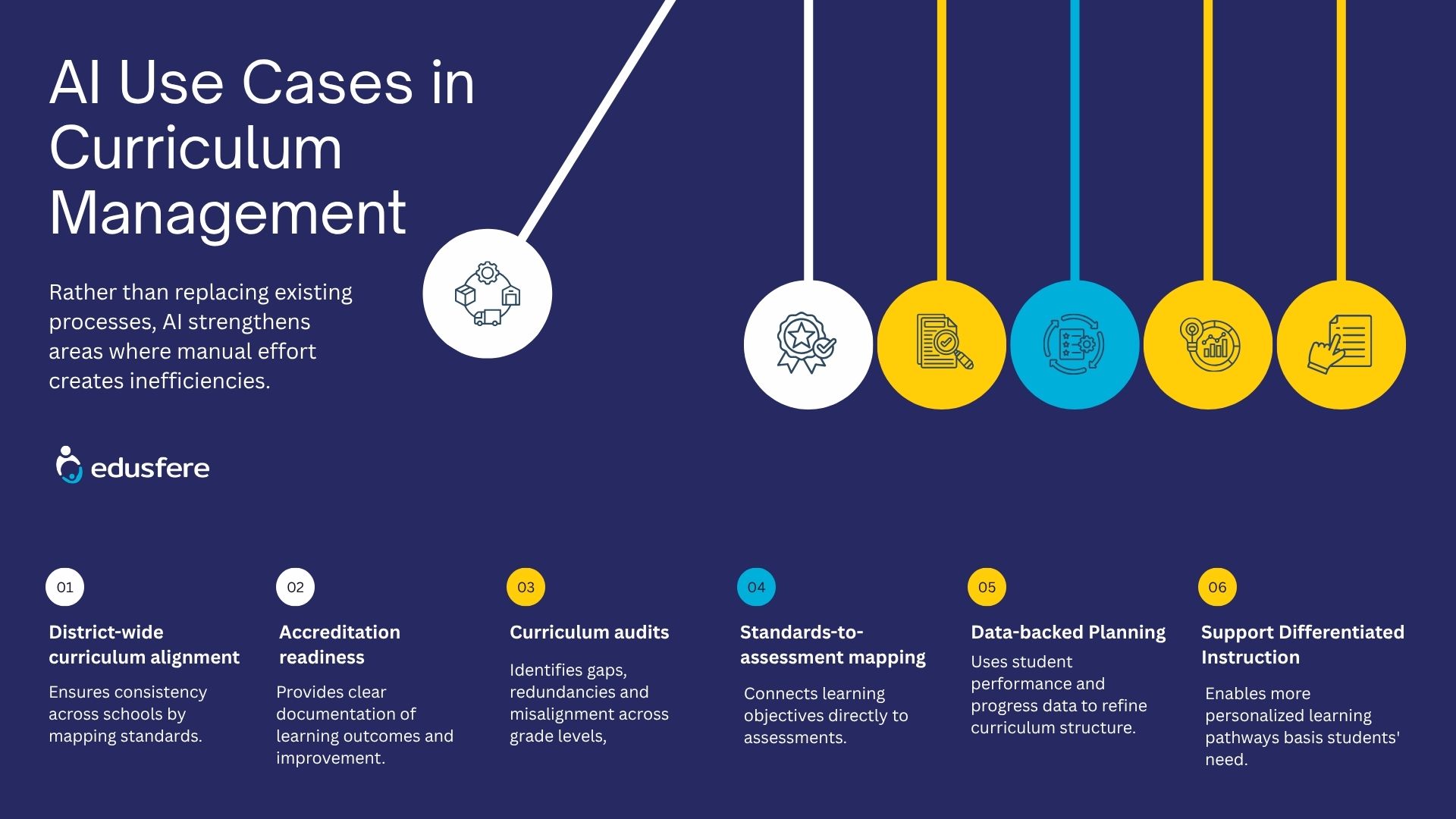
AI delivers the most value when applied to specific, high-impact challenges within K-12 systems. Rather than replacing existing processes, it strengthens areas where manual effort, fragmentation or lack of visibility create inefficiencies. Some of the common use cases include:
District-wide curriculum alignment: Ensures consistency across schools by mapping standards, assessments and instructional content into a unified framework.
Accreditation readiness (Cognia, ACSI): Provides clear documentation of standards alignment, learning outcomes and continuous improvement efforts required for accreditation reviews.
Curriculum audits and reviews: Identifies gaps, redundancies and misalignment across grade levels, significantly reducing the time required for audits.
Standards-to-assessment mapping: Connects learning objectives directly to assessments, ensuring that what is taught is accurately measured.
Data-informed curriculum planning: Uses student performance and progression data to refine curriculum structure and improve learning outcomes over time.
Cross-school consistency in multi-campus districts: Maintains alignment across multiple schools while allowing flexibility for contextual adaptation.
Support for differentiated instruction: Enables more personalized learning pathways by identifying where students need reinforcement or acceleration.
A Practical K-12 Scenario: AI in Action
Let's consider a mid-sized U.S. district conducting a curriculum audit across elementary and middle school programs. Using AI-driven curriculum mapping software, the district identified overlapping literacy standards across multiple grades, along with gaps in writing progression.
The system provided a clear, data-backed view of these inconsistencies, allowing curriculum leaders to make targeted adjustments quickly and effectively.
However, the AI also recommended deprioritizing certain interdisciplinary projects because they were not directly tied to measurable outcomes. This highlights an important limitation, i.e., while AI can optimize for efficiency and alignment, it cannot fully capture broader educational value. This balance between efficiency and intent is central to how AI should be used in curriculum design.
Risks and Limitations of AI in Curriculum Design
Despite its advantages, AI is not a complete solution. Its limitations must be carefully managed, particularly in K-12 environments. Here are some key risks involved:
Limited pedagogical understanding: AI can structure content but does not fully understand how students develop critical thinking, creativity or social-emotional skills.
Bias in data and recommendations: AI systems reflect the data they are trained on, which can lead to unintended bias in curriculum mapping and prioritization.
Over-standardization of learning: Excessive reliance on AI may result in rigid curriculum structures that limit teacher flexibility and student exploration.
Governance and compliance challenges: Without clear policies, schools may face issues related to data privacy, transparency and ethical use of AI.
These limitations reinforce the importance of human oversight. Educators remain essential in interpreting AI-generated insights and ensuring that curriculum decisions align with both academic goals and community values.
AI in Curriculum Design: Myths, Realities and What Actually Changes
As schools evaluate AI adoption, it is important to separate common misconceptions from practical realities.
In practice, AI supports curriculum planning and mapping, while educators remain central to decision-making.
AI guarantees better outcomes: AI improves structure and efficiency but learning outcomes still depend on teaching quality and student engagement.
AI-driven curriculum is fully objective: AI systems can reflect biases in their training data, requiring careful oversight.
AI implementation is a one-time solution: Effective use of AI requires continuous monitoring, training and refinement.
What actually changes is not the role of educators but the tools they use. AI enhances visibility, efficiency and adaptability but it does not replace professional judgment.
When Schools Should Use AI in Curriculum Planning
AI delivers the greatest value when applied strategically within well-defined goals. Schools should consider using AI when:
Curriculum mapping processes are manual or inconsistent
District-wide alignment and visibility are limited
Accreditation requires detailed documentation and evidence
Continuous curriculum improvement is a priority
At the same time, caution is needed when decisions involve cultural context, qualitative outcomes or areas where teacher autonomy is essential. The goal is not to automate curriculum design but to make it more informed, consistent and responsive.
The Role of Curriculum Mapping Software in K-12 Systems
As AI becomes more integrated into education, structured platforms are essential for effective implementation. Modern curriculum mapping software provides the foundation for managing curriculum at scale. These systems enable schools and districts to:
Align standards, assessments and instruction
Maintain consistency across schools and grade levels
Track curriculum effectiveness in real time
Support accreditation and compliance requirements
When combined with AI capabilities, these platforms provide actionable insights that help schools continuously refine their curriculum and improve outcomes.
Key Takeaways
AI is transforming curriculum planning, curriculum mapping and curriculum management in K-12 education by improving efficiency, alignment and adaptability.
It enables schools to manage complex standards frameworks, conduct faster curriculum audits and continuously refine learning programs based on data.
However, its limitations around pedagogy, bias and governance require careful implementation and strong human oversight.
The most effective approach is one where AI enhances curriculum design while educators remain central to decision-making.
FAQs About AI in K-12 Curriculum Design
Can AI fully design a K-12 curriculum?
AI can support curriculum planning and mapping but it cannot replace educators. Human expertise is essential for ensuring relevance and quality.
How does AI help with standards alignment?
AI automates the alignment of standards with instructional content and assessments, improving accuracy and reducing manual effort.
Is AI useful for accreditation processes like Cognia or ACSI?
Yes. AI supports documentation, alignment tracking and continuous improvement, all of which are critical for accreditation.
What are the main risks of using AI in curriculum management?
Key risks of using AI in curriculum management include bias, over-standardization, lack of governance and misinterpretation of AI-generated insights.
What should districts evaluate before adopting AI tools?
Districts should assess data privacy, system integration, teacher readiness and alignment with instructional goals.
Final Thoughts
AI has the potential to significantly enhance how K-12 curricula are designed and managed. It brings clarity, efficiency and adaptability to an increasingly complex educational landscape. However, curriculum design is ultimately about preparing students for the future, not just meeting standards.
AI can optimize the system. Educators must define its purpose.
Strengthen Curriculum Planning and Mapping with Edusfere
For K-12 schools, the challenge is not whether to adopt AI; it is how to do so in a way that strengthens alignment, supports educators and improves student outcomes. Edusfere provides a comprehensive platform for curriculum planning, curriculum mapping and curriculum management, designed specifically for modern school systems.
With Edusfere, schools and districts can:
Achieve clear, standards-aligned curriculum mapping
Streamline curriculum planning across grades and campuses
Gain real-time visibility into curriculum effectiveness
Leverage AI-driven insights through advanced curriculum mapping software
If your school is looking to modernize its curriculum while maintaining strong academic and pedagogical foundations, Edusfere offers a structured and scalable path forward.
Schedule a live Edusfere demo to see how we can support your curriculum management goals.