
Key Takeaways
- Legacy curriculum management software digitized curriculum. Modern software improves it.
- Collaboration and real-time visibility are now essential, not optional.
- AI is becoming a core part of curriculum planning and management.
- Automation simplifies standards updates and curriculum governance.
- Modern curriculum management helps schools build a connected, future-ready curriculum.
Over the last decade, K-12 schools have made significant strides in digitizing curriculum management. Legacy curriculum management software such as Curriculum Trak and Atlas helped districts move away from binders, spreadsheets and disconnected files by centralizing curriculum documentation and improving access for educators. For many schools, these solutions marked an important milestone in modernizing curriculum management. However, the demands placed on curriculum leaders today look very different from when these systems were first introduced.
State standards are updated more frequently, instructional teams collaborate across grade levels and campuses, accreditation processes require greater evidence of alignment and artificial intelligence (AI) is beginning to reshape how teachers plan instruction. At the same time, school leaders are expected to deliver greater consistency, transparency, and accountability without increasing administrative burden.
These changing expectations are prompting many districts and independent schools to reassess their approach to curriculum management. Rather than looking for software that simply stores curriculum documents, they are investing in modern curriculum management software that supports continuous improvement, collaboration and instructional excellence.
From Digital Storage to Connected Curriculum Management
The first generation of curriculum management software solved an important problem: replacing paper-based systems with digital repositories. Teachers could access curriculum online, administrators gained better oversight and schools found it easier to prepare for curriculum reviews and accreditation visits. Legacy curriculum management software like Curriculum Trak and Atlas provided a structured way to organize standards, units and lesson plans, helping schools establish consistency where previously there had been fragmentation.
Today, however, curriculum is no longer viewed as a static document that is reviewed once or twice a year. It has become a living framework that evolves alongside instructional practices, state requirements and student needs. As a result, schools are increasingly looking for platforms that not only document curriculum but also help improve it.
Why Are Schools Moving Beyond Legacy Curriculum Management Software?
The shift away from legacy curriculum management software is not necessarily driven by dissatisfaction with existing systems. Rather, it reflects how the role of curriculum itself has evolved.
1. Curriculum is now a continuous process
Curriculum development is no longer limited to annual planning meetings. Teachers refine lessons throughout the year, departments review instructional strategies regularly and curriculum leaders respond to evolving standards and assessment data. Static document repositories struggle to support this continuous cycle of improvement.
Modern curriculum management software enables curriculum to evolve in real time, ensuring that every stakeholder works from the latest version without duplicate files or conflicting documents.
2. Collaboration has become essential
Effective curriculum planning is increasingly collaborative. Grade-level teams work together to maintain consistency, departments align instructional priorities and curriculum directors oversee implementation across multiple schools. When collaboration happens through emails, shared drives or disconnected documents, valuable institutional knowledge is often lost.
Modern curriculum management softwares like Edusfere provide a shared workspace where educators can review, refine and improve curriculum together, creating a single source of truth for the entire school community.
3. Standards Alignment requires greater agility
State standards continue to evolve and schools must respond quickly while maintaining instructional consistency. Updating standards manually across multiple courses can consume significant administrative time and increase the risk of inconsistencies.
Modern curriculum management software addresses this challenge through automated or cascading updates. This allows curriculum leaders to implement changes efficiently while maintaining alignment across grades and subjects.
4. School leaders need better visibility
Principals and curriculum directors need more than access to curriculum documents. They need meaningful insights. Questions such as the ones mentioned below should not require hours of manual analysis.
- Where are our curriculum gaps?
- Are standards vertically aligned?
- Which courses require revision?
Modern curriculum management softwares like Edusfere provide real-time dashboards with live data and curriculum mapping tools. These enable school leaders to make informed instructional decisions with confidence.
5. AI is becoming part of everyday planning
Generative AI is rapidly finding its place in education. Teachers are using AI to brainstorm lesson ideas, differentiate instruction, develop classroom activities, and streamline planning tasks. When these workflows exist outside the curriculum platform, however, schools risk fragmented planning and inconsistent documentation.
Modern curriculum management software increasingly incorporates AI-assisted workflows, enabling educators to work more efficiently while maintaining curriculum quality, consistency and governance.
What Defines Modern Curriculum Management Software?
While every school has unique priorities, today's leading curriculum management softwares share several characteristics that distinguish them from legacy curriculum management systems.
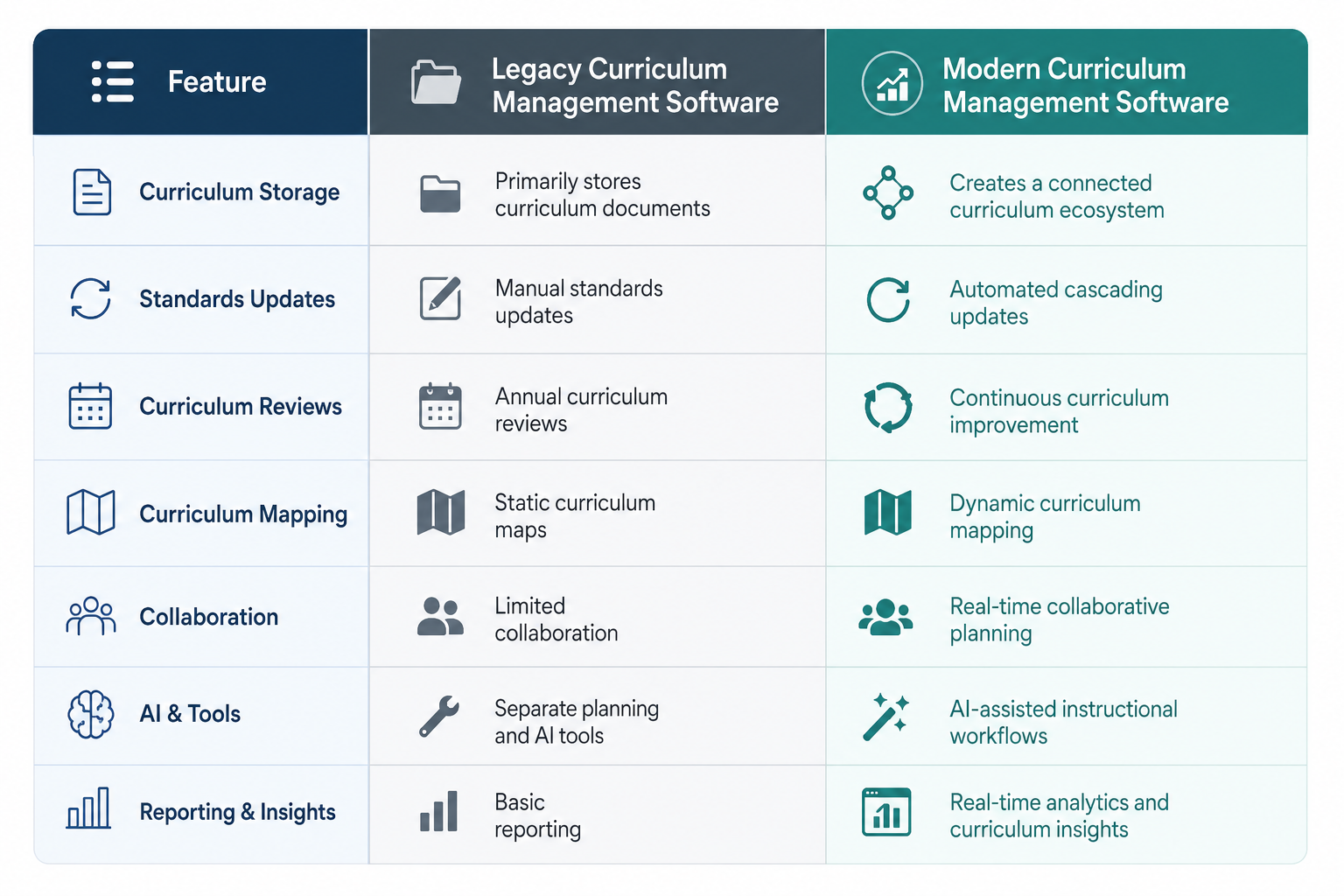
The difference is not simply technological. It represents a shift from documenting curriculum to actively supporting instructional improvement.
Questions Every School Leader Should Ask While Evaluating a New Curriculum Management Software
Selecting curriculum management software is a long-term investment that affects teachers, administrators and students alike. Before choosing a platform, school leaders should consider the following questions:
- Can the platform provide visibility into curriculum alignment across grades and departments?
- How easily can curriculum be updated when standards change?
- Does it encourage collaboration rather than relying on external tools?
- Can teachers quickly adopt the platform with minimal training?
- Does it simplify accreditation and curriculum review processes?
- Does it support AI-assisted planning while maintaining instructional quality?
- Will the platform continue to meet the school's needs as it grows?
These questions shift the conversation from software features to long-term educational outcomes.
Looking Beyond Software: Building a Stronger Curriculum Management Ecosystem
The most successful schools understand that curriculum management is about far more than documentation. A well-managed curriculum promotes instructional consistency, strengthens collaboration among teachers, preserves institutional knowledge and provides school leaders with the visibility they need to make informed decisions.
As teacher turnover, evolving standards, and increasing accountability continue to shape K-12 education, curriculum management software must support continuous collaboration rather than simply acting as digital filing cabinets. This is why many schools are moving toward modern curriculum management software designed around the way educators work today.
Why are schools exploring modern curriculum management software like Edusfere?
As schools rethink their approach to curriculum management, many are looking beyond platforms designed primarily for documentation and toward solutions that actively support teaching, leadership and continuous curriculum improvement. Modern curriculum management software like Edusfere is built around the way curriculum teams work today. Rather than functioning as a repository for curriculum documents, Edusfere connects curriculum mapping, vertical and horizontal alignment, standards management, lesson planning, instructional calendars, collaborative workflows and AI-assisted planning within a single platform.
Edusfere's biggest differentiators are its ability to keep curriculum aligned with respective standards and ease of analytical report generation, which is crucial for accreditation visits. When standards are updated or curriculum changes are made, cascading updates ensure those changes flow across related courses and learning plans. This helps schools maintain consistency without the administrative burden of manually updating multiple documents.
As a modern curriculum management software, Edusfere also bridges the gap between curriculum leaders and classroom teachers. While administrators gain real-time visibility into curriculum implementation, standards coverage and alignment across grades, teachers can build lessons, collaborate with colleagues and leverage AI tools directly within the same workflow. This aids in eliminating the need to switch between multiple disconnected applications.
Unlike traditional curriculum management software that often focuses on storing curriculum, modern curriculum management software like Edusfere is designed to support the entire instructional lifecycle. The result is a connected curriculum ecosystem that helps schools improve collaboration, strengthen governance, accelerate accreditation readiness and ensure curriculum evolves alongside changing educational priorities.
Here's a quick client feedback from a Maryland-based school:
“I have only been exploring and using Edusfere for a few weeks, but I absolutely LOVE it! The ease of writing lesson plans has finally been discovered! Sharing plans and posting them in our school communication system is so beautiful! Thank you for saving me hours of work. That is such a blessing.”
Shana Fry, K-12 Educator
Looking Ahead
Curriculum management is no longer just about organizing documents. It's about creating the foundation for consistent, high-quality teaching and learning across an entire school or district.
Legacy curriculum management software, including platforms like Curriculum Trak and Atlas, played a pivotal role in helping schools transition from paper-based processes to digital curriculum documentation. As instructional priorities continue to evolve, however, many school leaders are recognizing that documentation alone is no longer enough. They need curriculum management software that enables collaboration, adapts to changing standards, supports AI-assisted planning and provides real-time visibility into curriculum implementation.
That's why more K-12 schools are embracing modern curriculum management software that treats curriculum as a living, connected ecosystem rather than a collection of isolated documents. By bringing together curriculum mapping, standards alignment, collaborative planning and instructional workflows in one place, these platforms help schools spend less time managing curriculum and more time improving it. Ultimately, the best curriculum management software doesn't simply organize what teachers have already created. It helps schools build a more aligned, collaborative and future-ready instructional program. As educational expectations continue to evolve, platforms like Edusfere are enabling school leaders to move beyond curriculum management toward continuous curriculum improvement.
Frequently Asked Questions
What is legacy curriculum management software?
Legacy curriculum management software refers to earlier-generation platforms primarily designed to digitize and organize curriculum documents, standards and instructional plans. While these systems helped schools move beyond paper-based processes, they often have limited capabilities for collaboration, automation, analytics and AI-assisted planning.
What is modern curriculum management software?
Modern curriculum management software is designed to support the entire curriculum lifecycle. In addition to curriculum mapping and standards alignment, it enables collaborative planning, automated curriculum updates, AI-assisted workflows, real-time reporting and continuous curriculum improvement.
Why are K-12 schools replacing legacy curriculum management software?
Many schools are looking for platforms that reduce administrative effort, improve collaboration, provide greater visibility into curriculum implementation and support evolving instructional needs. Modern curriculum management software helps schools manage curriculum more efficiently while adapting to changing standards and teaching practices.
How does AI improve curriculum management?
AI helps educators streamline lesson planning, generate instructional ideas, align lessons with standards and reduce repetitive administrative tasks. When integrated into curriculum management software, AI supports teachers without disrupting established curriculum governance.
What should school leaders look for in a modern curriculum management platform?
School leaders should look for features such as curriculum mapping, vertical and horizontal alignment, standards management, collaborative planning, automated or cascading updates, AI-assisted lesson planning, real-time analytics, accreditation readiness and an intuitive user experience for teachers and administrators.
How is Edusfere different from traditional curriculum management software?
Edusfere is designed as a connected curriculum ecosystem rather than a document repository. It brings together curriculum mapping, standards alignment, vertical and horizontal alignment, collaborative planning, AI-assisted lesson planning, instructional calendars and cascading updates within a single platform. This further helps schools move from static curriculum documentation to continuous curriculum improvement.
Ready to Modernize Your Curriculum Management?
Discover how Edusfere helps K-12 schools streamline curriculum mapping, strengthen standards alignment, support collaborative planning and prepare for the future with a modern curriculum management platform.
Book a personalized demo today and see how connected curriculum management can transform teaching and learning across your school.