
Key Takeaways
- Differentiated lesson planning starts with a shared learning goal.
- Differentiation is not the same as individualized instruction.
- Content, process, product and learning environment can all be differentiated.
- Curriculum mapping provides essential context.
- Curriculum management can strengthen that connection by bringing in a more coherent workflow.
- Teacher judgment remains central.
A well-planned lesson does not necessarily work equally well for every student. In the same classroom, one student may need additional context before engaging with a new concept. Another may already be ready to apply it independently. A third may understand the idea but need a different way to demonstrate that understanding. These differences are a normal part of teaching, and they are one reason a single instructional pathway does not always serve an entire class well.
Differentiated lesson planning offers a practical way to respond. Instead of creating a separate lesson for every learner, teachers begin with a shared learning goal and deliberately build flexible pathways to reach it. The learning can remain rigorous and aligned while the support, process, resources or demonstration of understanding varies. For K-12 schools, that distinction matters. Differentiation should strengthen instruction without turning lesson planning into an unmanageable exercise.
What Is Differentiated Lesson Planning?
Differentiated lesson planning is the practice of designing instruction around a clear learning goal while making purposeful adjustments for differences in student readiness, needs, interests or learning profiles.
The approach is closely associated with Carol Ann Tomlinson's framework for differentiated instruction. ASCD describes differentiation as a proactive approach that uses assessment and knowledge of students to shape instruction. Its framework identifies four key areas that teachers can adjust, i.e., content, process, product and learning environment.
In practical terms, differentiated lesson planning starts with one essential question:
What should students learn and what might different learners need in order to get there? The learning goal may remain common across the class. The route toward that goal does not have to be identical.
That could mean providing additional scaffolding for one group, more complex material for another or different ways for students to demonstrate what they understand. The point is not to make learning easier or harder for its own sake. It is to make instruction more responsive while preserving meaningful expectations.
Why One Learning Goal Does Not Always Mean One Learning Path
No K-12 classroom is truly uniform. Students bring different levels of prior knowledge, confidence, language proficiency, interests and experience to the same lesson. When instruction follows only one pathway, some students may struggle to access the content while others are ready to move beyond it. Differentiation gives teachers a structured way to respond without abandoning a common curriculum.
Consider a Grade 7 social studies lesson on the causes of the American Revolution. The learning objective might require students to explain two causes and support their explanation with historical evidence.
The objective can remain the same for the class. The learning experience can still vary.
Students who need additional support might work with an annotated primary source and a vocabulary bank. Other students might compare several sources independently. Students ready for greater challenge could examine competing historical interpretations before developing an evidence-based explanation.
The teacher has not created three separate curricula. Instead, the lesson provides different entry points into the same essential learning. That is the practical value of differentiated lesson planning.
What Can Teachers Actually Differentiate?
Differentiation does not require teachers to change everything about a lesson. In many cases, a focused adjustment is enough.
Content: How Students Access the Learning
Content refers to the knowledge, concepts, and skills students are expected to engage with. Teachers can provide visual representations, vocabulary support, accessible versions of texts, supplementary resources or additional background information. These choices can help students engage with the essential content without changing the purpose of the lesson.
The distinction between essential learning and supporting access is important. Differentiation should not automatically mean reducing the intellectual demand of the curriculum.
Process: How Students Work With the Content
Process refers to how students engage with new knowledge and develop understanding. A teacher might use guided practice with one group, collaborative inquiry with another, and independent application with a third. Flexible grouping can also allow students to work with different peers depending on the learning task.
ASCD's differentiated instruction framework recognizes that students may need different forms of support, grouping, pacing and engagement as they work through content. The important consideration is purpose. Variation should respond to an identifiable learning need rather than simply create more activity.
Product: How Students Demonstrate Understanding
Product refers to the evidence students produce to demonstrate their learning. Depending on the objective, this might be a written explanation, presentation, concept map, model, performance or oral response. Different formats can provide appropriate ways for students to communicate their understanding. The format can change without changing the learning expectation.
This also connects with Universal Design for Learning. CAST recommends providing multiple options for action and expression because students may encounter different barriers when demonstrating what they know.
Learning Environment: What Conditions Help Students Learn?
The environment surrounding a lesson can also be differentiated. Students may benefit from flexible seating, independent work, structured collaboration, targeted teacher support or accessible and assistive technologies. The appropriate choice depends on the learners, the task and the learning objective.
CAST's UDL framework similarly emphasizes multiple options for engagement and representation as part of designing more accessible learning environments.
What Does a Differentiated Lesson Plan Look Like?
Consider a Grade 5 science lesson on how changes in an ecosystem can affect food chains. The teacher establishes one core learning objective. From there, different elements of the lesson can provide appropriate levels of support and challenge.
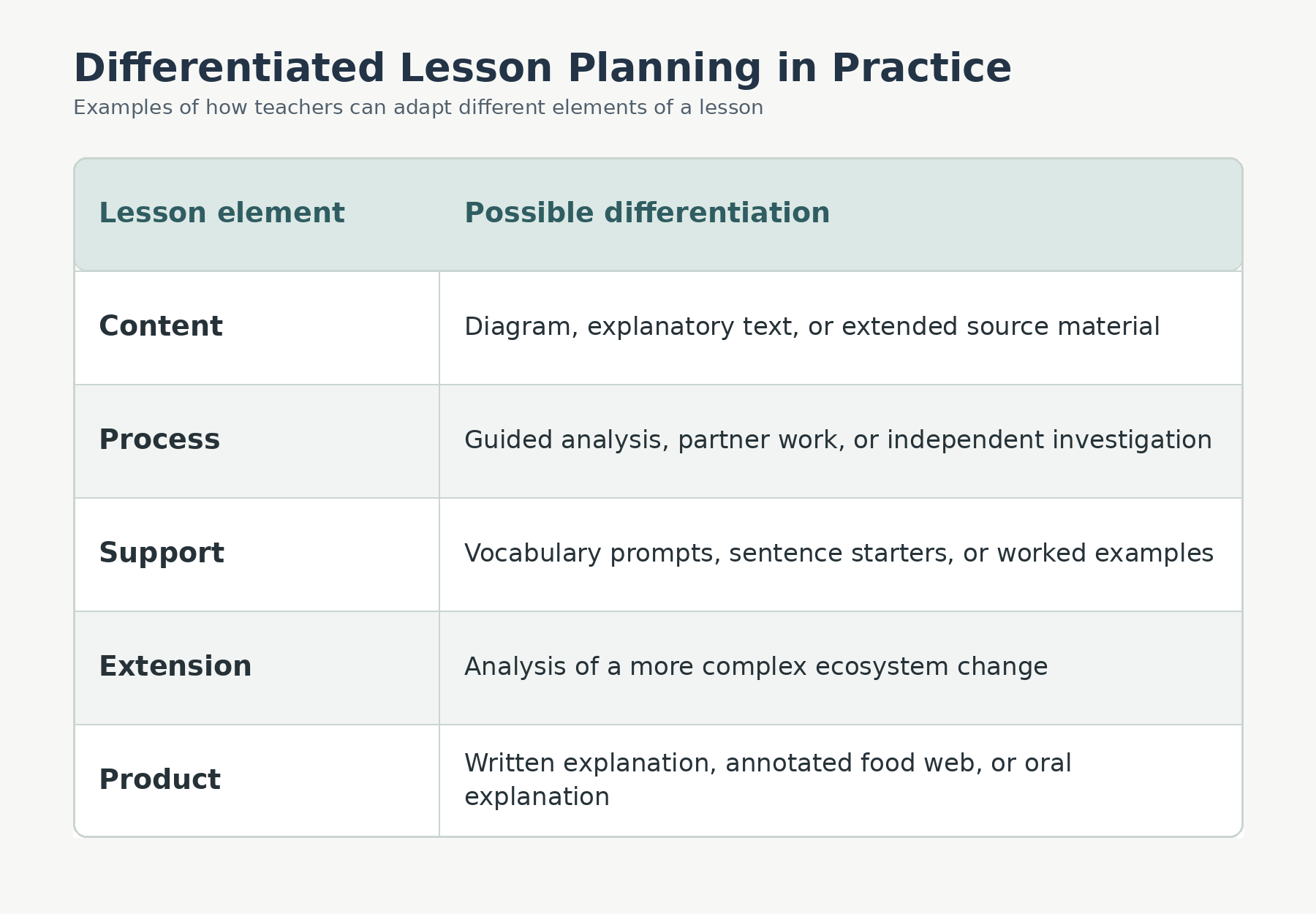
The teacher is not creating five different lessons. The lesson has been designed with deliberate flexibility. That distinction matters because differentiation can quickly become unsustainable when it is treated as a requirement to produce multiple versions of everything. Strong planning focuses on the points where variation will genuinely improve access, engagement, or challenge.
Differentiation Should Not Become a Second Curriculum
For school leaders, this is an important line to draw.
Differentiation should operate within the curriculum, not create a parallel curriculum that teachers must manage alongside it. A student who needs additional scaffolding still deserves access to meaningful curriculum content. A student who is ready for greater challenges does not simply need more work. Both need an appropriate route toward meaningful learning.
What is the Difference Between Differentiated and Individualized Instruction?
Differentiated and individualized instructions are related but they are not interchangeable.
Differentiated instruction involves responsive adjustments within classroom teaching. Teachers may vary resources, scaffolding, grouping, tasks or forms of expression while maintaining shared learning goals.
Individualized instruction goes further. It involves providing different tasks and support at the individual level, often with greater variation in activities or pacing. The Education Endowment Foundation notes that individualized instruction can be effective but also highlights the organizational demands involved when teachers manage individual activities. Its evidence rating is based on limited evidence. This distinction is useful in practice.
Differentiation does not require teachers to build a unique instructional program for every student. Flexible groups, targeted scaffolds, varied resources and responsive teaching can address meaningful differences without turning every lesson into an individualized program.
Where Does Differentiation Fit Into the Curriculum?
A differentiated lesson is more effective when teachers understand where it sits within the broader curriculum. A lesson is one point in a longer learning sequence. Teachers need to know what students have already learned, what they are expected to learn now and what knowledge or skills they will need next.
This is where curriculum mapping becomes particularly valuable.
A curriculum map can provide visibility into standards, unit goals, prerequisite knowledge, assessment points, instructional resources and the progression of learning across grades or subjects. With that context, teachers can ask more useful questions:
- What is the essential learning in this lesson?
- What prerequisite knowledge might some students need?
- Where could students require additional scaffolding?
- Who may be ready for greater depth or complexity?
- How does this lesson connect to what students have already learned?
- What does it prepare students to learn next?
The resulting sequence is more coherent:
Curriculum expectations → Unit goals → Lesson objectives → Differentiated pathways → Evidence of learning
Differentiation then becomes part of curriculum delivery rather than a disconnected classroom strategy.
Why Curriculum Mapping Matters for Differentiated Planning
Curriculum mapping gives teachers the context they need to make informed instructional decisions. Without that context, differentiation can become narrowly focused on the immediate lesson. Teachers may spend time creating engaging activities without being able to see how those activities connect to prior learning or future expectations.
A well-maintained curriculum map provides that larger picture. It helps teachers identify prerequisite skills, understand curriculum progression, connect lessons to standards and collaborate around shared expectations. It can also reveal repetition or gaps that may otherwise remain hidden across classrooms and grade levels.
For school leaders, this visibility matters just as much. Curriculum mapping can help leaders examine whether classroom planning reflects the intended curriculum. It can also create a stronger foundation for collaborative planning and instructional conversations.
How Can Teachers Create a Differentiated Lesson Plan?
A practical approach does not need to add layers of complexity to an existing planning process.
1. Define the essential learning
Begin with the outcome. What should students know, understand or be able to demonstrate by the end of the lesson? A precise objective gives every subsequent planning decision a clear anchor.
2. Identify likely learner needs
Use prior assessment, student work, classroom observations and knowledge of the curriculum sequence. Look for both potential barriers and opportunities for greater challenges.
3. Decide where variation will add value
Not every element of the lesson needs to change. Consider whether students need different resources, levels of scaffolding, grouping arrangements, task complexity or ways to demonstrate understanding.
Choose only what serves the learning.
4. Build flexible pathways
Keep the number of pathways manageable. A common mini-lesson might lead into guided practice for some students, independent application for others and an extension task for those ready to go further.
5. Use evidence to shape what comes next
Differentiation should continue beyond the lesson. Student responses, formative assessment, questions and completed work can show who needs reinforcement, reteaching, additional challenge or another route into the concept.
Common Differentiation Mistakes to Avoid
Differentiation becomes difficult when it is treated as more work rather than better design.
Creating a separate lesson for every student: This is rarely sustainable. Flexible pathways and targeted support can provide meaningful differentiation without multiplying a teacher's workload.
Lowering expectations instead of adjusting access: Students may need more scaffolding without needing less rigorous learning. The aim is to make the learning accessible, not automatically easier.
Assuming more work means more challenge: An additional worksheet is not necessarily a meaningful extension. Greater challenges can involve deeper reasoning, greater independence, application, analysis or transfer.
Creating permanent ability groups: Student needs can change across subjects, concepts and tasks. Flexible grouping allows teachers to respond to those differences without attaching permanent labels to learners.
Differentiating without checking curriculum alignment: A different activity is not automatically meaningful differentiation. It should still contribute to the intended learning and remain connected to the curriculum.
Treating differentiation as an afterthought: The strongest lessons consider learner variability during planning. Differentiation becomes more sustainable when it is integrated into instructional design rather than added after the lesson is complete.
How Can School Leaders Make Differentiated Planning Sustainable?
Differentiation cannot rest entirely on individual teachers.
School leaders influence the conditions in which it can succeed. That includes providing a coherent curriculum framework, time for collaborative planning, meaningful formative assessment practices, relevant professional learning and systems that make curriculum information accessible.
ASCD's guidance on differentiated learning also emphasizes the role of leadership, professional learning, collaboration, and time in supporting effective implementation. It is also important not to turn differentiation into a compliance exercise. A differentiated lesson should not be judged by the number of activities or worksheet versions a teacher produces. A stronger measure is whether students have appropriate access to meaningful learning and whether the lesson remains aligned with the curriculum.
For school leaders, the goal is not uniformity. It is curricular coherence with room for professional judgment.
Frequently Asked Questions About Differentiated Lesson Planning
What is differentiated lesson planning in simple terms?
Differentiated lesson planning means designing a lesson around a shared learning goal while providing appropriate variations in support, resources, activities or ways students demonstrate understanding.
What are the four main areas of differentiated instruction?
The commonly cited areas are content, process, product and learning environment. ASCD connects these areas to differences in student readiness, interest and learning profile.
Does differentiated instruction mean every student gets different work?
No. Differentiation does not require a completely different assignment for every student. Teachers can use flexible grouping, targeted scaffolds, varied resources or different forms of support while maintaining a common essential learning goal.
What is a practical example of differentiated lesson planning?
A teacher might ask every student to explain a scientific concept while providing different levels of scaffolding. Some students may use a visual organizer and vocabulary prompts, while others work independently. Students ready for greater challenges might apply the concept to a more complex scenario.
What is the difference between differentiated and individualized instruction?
Differentiated instruction provides responsive variations within classroom teaching. Individualized instruction provides different tasks and support at the individual level and may involve greater variation in pacing. The Education Endowment Foundation (EEF) notes that individualized instruction can be effective but can also increase the organizational demands placed on teachers.
How does curriculum mapping support differentiated lesson planning?
Curriculum mapping shows how a lesson connects to standards, unit goals, prerequisite learning, assessment and future instruction. That context helps teachers differentiate without losing sight of curriculum progression.
Can curriculum management software support differentiated lesson planning?
Yes. Curriculum management software can connect curriculum expectations, standards, maps, resources and lesson plans. This can make relevant context easier to access and support collaboration. The instructional decisions themselves remain with educators.
7. Is differentiated instruction the same as Universal Design for Learning?
No. The two approaches are related but distinct. Differentiated instruction commonly involves responsive adjustments based on learner needs. UDL focuses on proactively designing learning environments with multiple means of engagement, representation and action and expression. CAST provides the current UDL framework.
Should differentiated lessons have different learning objectives?
Not necessarily. Students can often work toward a shared essential objective through different pathways. Changing the objective should be based on a clear curricular or instructional rationale.
How can school leaders evaluate differentiated lesson planning?
Look beyond the number of activities or lesson versions. Consider whether learning goals are clear, differentiation is informed by evidence, students are appropriately challenged, assessment reflects the intended learning and lesson planning remains connected to curriculum expectations.
What should teachers differentiate first?
Start with the learning goal and the learner needs. Once the essential learning is clear, identify the barrier or opportunity that matters most. Then decide whether content, process, support, product, grouping or the learning environment needs to change.