

Key Takeaways
- Curriculum compliance now requires visibility, not just documents.
- N.J.A.C. 6A:8 signals stronger expectations for alignment, pacing and continuous improvement.
- Manual systems create hidden risk, inconsistency, and wasted time.
- Future-ready districts will use smarter systems, faster review cycles and better evidence workflows.
- Curriculum mapping software can reduce workload while improving governance.
- Edusfere helps schools turn compliance pressure into strategic capability.
Why N.J.A.C. 6A:8 Matters More Than Ever
Many school systems built their curriculum processes in a different era; one where standards changed less frequently, documentation requests were less complex and most planning happened within individual schools or departments. In that environment, binders, spreadsheets and shared folders often felt sufficient. Today, they rarely are.
What the regulation explicitly requires
N.J.A.C. 6A:8 establishes that districts must implement curriculum and instruction aligned to the New Jersey Student Learning Standards (NJSLS), support all learners in achieving those standards, and demonstrate student progress through appropriate assessment systems. While the regulation does not prescribe specific tools or formats, it requires districts to maintain coherent, standards-based instructional systems that can be reviewed when needed.
The demands on K-12 leaders have changed. Districts are expected to show alignment to standards, support diverse learners, document instructional consistency and improve continuously using evidence. That is why New Jersey’s N.J.A.C. 6A:8 matters. The chapter governs Standards and Assessment and outlines expectations for curriculum, instruction, student achievement and continuous improvement aligned with the New Jersey Student Learning Standards (NJSLS). In 2025, the chapter was formally readopted and revised, an important sign that curriculum governance is becoming more dynamic and more central to district operations.
The regulation also reinforces that districts must design curriculum so all students can demonstrate required knowledge and skills, while providing appropriate support for multilingual learners, students with disabilities, students in alternative settings and students identified as gifted and talented. In practical terms, curriculum is no longer a background process. It is one of the most visible indicators of system quality. For school leaders, that shift creates several clear priorities such as:
Standards alignment must be clearly demonstrated across curriculum and instruction: Leaders need to know where standards are introduced, reinforced, assessed and mastered across grade levels. If alignment lives in disconnected files, consistency becomes difficult to verify.
Pacing guides as strategic tools: Many districts use pacing guides as strategic tools to support consistent implementation, even though they are not explicitly mandated. Sequencing and timing are not administrative extras. They help ensure equitable access to learning and coherent progression across classrooms.
Lesson planning should connect to approved curriculum: Teachers need professional autonomy, but within a framework tied to district priorities, assessments and expected outcomes.
Documentation should be organized and accessible: Documentation should be organized and accessible so it can be provided efficiently when requested by oversight bodies including boards, auditors, accreditors and leadership teams increasingly expect accurate evidence, not last-minute assembly.
Continuous improvement is now expected: The strongest systems review and refine curriculum regularly rather than waiting for periodic overhauls.
The real compliance risk is rarely missing curriculum, it is invisible curriculum.
How Can This Shape the Future of K-12 Schools in New Jersey?
The most significant impact of N.J.A.C. 6A:8 may not be immediate compliance tasks. It may be the long-term shift in how districts are expected to operate. Regulations often signal future priorities before they become standard practice and this chapter points toward a more transparent, accountable and future-ready model of schooling.
Recent updates tied to the code emphasize public access to curriculum resources, stronger pathways to college and careers, expanded access to advanced coursework, support for multilingual learners and the use of data to guide improvement. These are not isolated policy changes. Together, they suggest that districts will be asked to demonstrate both academic quality and operational maturity. That has several implications for K-12 schools over the next few years:
Increasing emphasis on transparency: Increasing emphasis on transparency, with many districts expanding how they communicate curriculum expectations to families and stakeholders. Families and communities may increasingly expect easy access to curriculum expectations, pacing and instructional priorities. Trust will depend more on clarity.
Faster accountability cycles: Leaders may need quicker answers on implementation progress, subgroup outcomes and program effectiveness rather than relying only on annual reporting.
Stronger equity expectations: Schools may be asked not only what programs they offer but who can access them and who benefits from them.
Curriculum tied to readiness outcomes: College, career and life readiness are becoming central measures of success alongside traditional academic metrics.
Continuous review as the norm: Five-year refresh cycles are giving way to lighter, more frequent improvement cycles informed by data and educator feedback.
Greater reliance on structured systems and digital tools to manage curriculum complexity: As expectations rise, districts will need smarter systems for standards tagging, resource search, approvals, reporting and workflow efficiency.
The next competitive advantage in K-12 education is not more documents, it is better systems.
What N.J.A.C. 6A:8 Requires in Practice
While N.J.A.C. 6A:8 does not prescribe how schools should manage curriculum operationally, it establishes clear expectations that districts must be able to demonstrate:
- Alignment of curriculum and instruction to the New Jersey Student Learning Standards (NJSLS)
- Access to equitable learning opportunities for all student groups
- Use of assessment to monitor student progress
- Ongoing review and improvement of instructional programs
In practice, this means districts must ensure that curriculum is not only well-designed, but also consistently implemented and explainable when reviewed by leadership, boards, or external bodies.
Why Traditional Curriculum Systems Start to Break Down
Most schools do not struggle because they lack commitment. They struggle because curriculum complexity has outgrown the tools supporting it. Multi-campus coordination, evolving standards, staffing changes, accreditation cycles and parent expectations create pressure that spreadsheets were never designed to handle.
When systems are fragmented, the impact is felt first by teachers and instructional leaders. Time that should go toward improving instruction is spent searching for files, reconciling versions or recreating materials that already exist somewhere else. Over time, those inefficiencies become leadership problems as well. In districts still relying on manual processes, the same patterns appear repeatedly:
- Multiple versions of the truth: Different teams use different files, creating confusion and inconsistent implementation.
- Slow updates: Changes to standards or district priorities can take months to cascade across schools.
- Limited visibility: Leaders cannot easily see progress, gaps, overlaps or support needs.
- Teacher friction: Administrative work expands while planning time shrinks.
- Weak audit readiness: Evidence gathering becomes reactive, manual and stressful.
These are not minor inconveniences. They affect staff confidence, onboarding of new hires, consistency for students and the district’s ability to improve at speed.
Manual vs Modern Curriculum Management
As expectations rise, the real question for leaders is not whether curriculum systems matter. It is whether current systems are capable of meeting modern demands. The contrast between manual processes and connected platforms is increasingly clear.
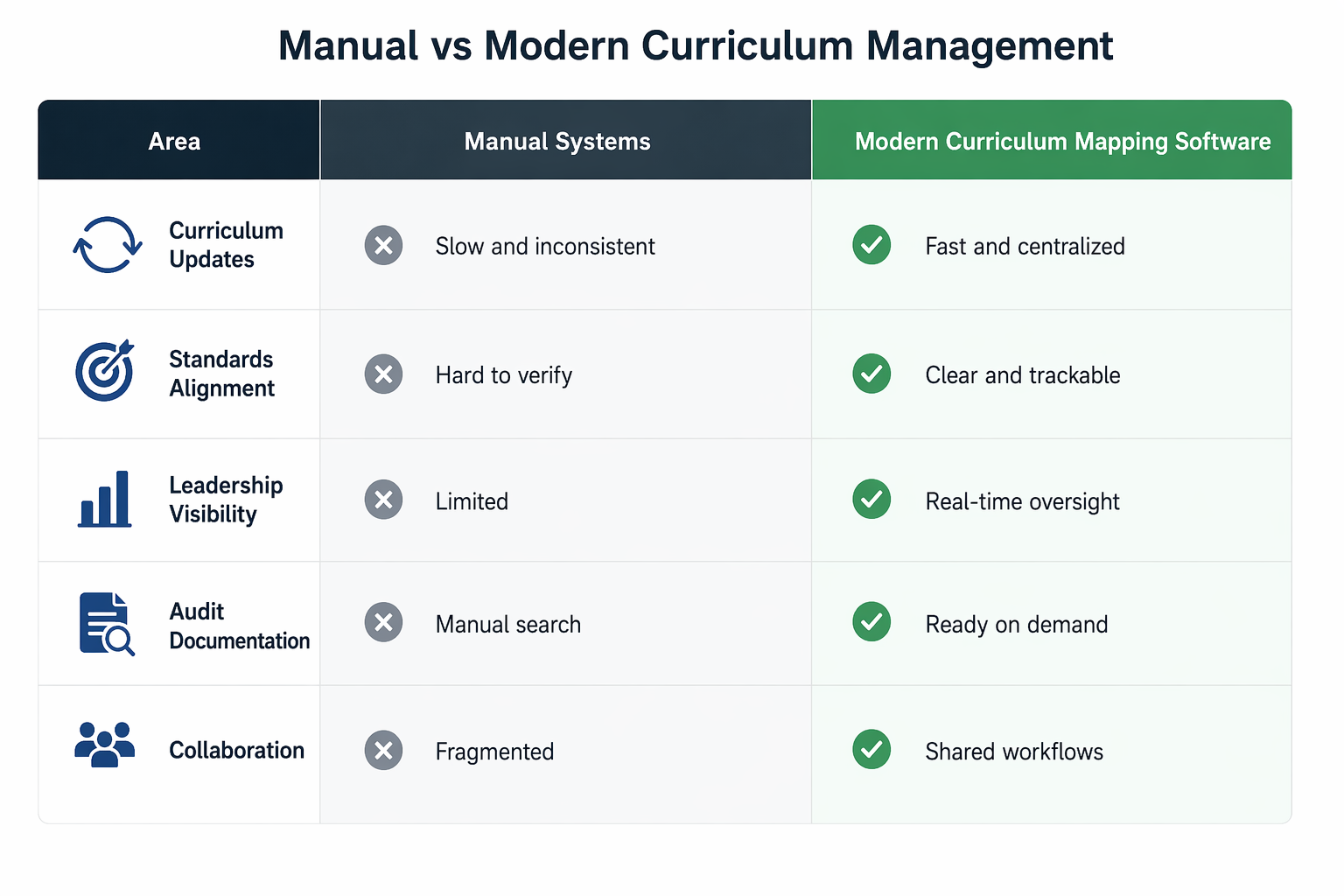
A stronger system does more than save time. It improves trust, reduces operational friction and gives leaders clearer control over one of their most important responsibilities.
How Edusfere Helps Schools Move From Compliance to Capability
For many districts, the challenge is not understanding what needs to improve. It is finding a practical way to improve it without adding more complexity. That is where purpose-built platforms create value. Edusfere is designed for schools that need curriculum systems built for governance, collaboration and long-term improvement. Rather than treating curriculum as a collection of static documents, Edusfere helps schools manage it as a living operational framework.
That shift matters because districts are being asked to do more with limited time and staffing. Systems that centralize curriculum work can reduce duplication, accelerate updates, improve onboarding for new staff and make leadership oversight far easier.
While N.J.A.C. 6A:8 does not require specific software, many districts adopt structured curriculum management systems to more effectively meet expectations around alignment, documentation and continuous improvement.
Where Edusfere creates strategic value:
- Centralized curriculum mapping: Organize curriculum by grade, subject, school or program in one trusted system.
- Built-in standard alignment: Map units and lessons directly to standards for easier compliance and clearer instruction.
- Connected lesson planning: Teachers build from approved curriculum rather than starting from scratch.
- Version control and audit trails: Track updates, approvals and revisions with confidence.
- Continuous review cycles: Identify gaps, duplication, outdated content or pacing issues early.
- Scalable curriculum management: Standardize processes across one school or an entire district.
Helpful tools alongside Edusfere:
Many districts also strengthen results by pairing curriculum platforms with complementary systems such as assessment dashboards, PLC review workflows, professional learning calendars, accreditation evidence repositories, AI-assisted search tools and observation systems tied to instructional priorities.
A Practical Readiness Plan for School Leaders
The goal is not to add new processes, but to ensure existing curriculum systems can clearly demonstrate alignment, access and instructional consistency when required. Once leaders understand where expectations are heading, the next step is execution. The most effective districts do not wait for pressure to build. They create simple, repeatable systems that improve readiness over time. A practical starting point looks like this:
- Audit current curriculum systems: Identify where curriculum maps, pacing guides, lesson plans and evidence currently live. Fragmentation is often the first risk to solve.
- Verify standards alignment: Check whether units, assessments, and instructional resources clearly align to the NJSLS across grades and schools.
- Centralize workflows and ownership: Create one shared process for updates, approvals, collaboration and reporting.
- Improve evidence retrieval: Ensure documentation can be produced quickly for audits, accreditation or board requests.
- Build a continuous review cycle: Replace infrequent overhauls with regular light-touch updates informed by data and educator feedback.
Small operational improvements, repeated consistently, often create the biggest long-term gains.
Frequently Asked Questions about N.J.A.C 6A:8
What is N.J.A.C. 6A:8?
It is the New Jersey Administrative Code chapter covering Standards and Assessment. It outlines expectations for curriculum, instruction, student outcomes and continuous improvement aligned to the NJSLS.
Is N.J.A.C. 6A:8 a law or a regulation?
It is an administrative regulation within the New Jersey Administrative Code, implemented through the state’s education governance process.
Why does it matter for principals and administrators?
Because it affects how schools demonstrate standards alignment, instructional quality, support for diverse learners and readiness for audits or accreditation.
What is curriculum mapping software?
A system that helps schools organize curriculum maps, manage pacing guides, align standards, connect lesson planning and maintain documentation in one platform.
How does curriculum mapping support compliance?
It creates visibility into what is taught, when it is taught, how it aligns to standards and what evidence exists; making reviews and decisions faster and more reliable.
How often should curriculum maps be reviewed?
Best practice is continuous light-touch review with formal checkpoints each term or school year, plus updates whenever standards or district priorities change.
What should pacing guides include?
Essential standards, unit sequence, instructional timelines, assessment checkpoints and flexibility notes for teacher judgment.
Can small districts benefit from curriculum mapping software?
Yes. Smaller districts often gain faster because centralized systems reduce dependency on a few individuals and improve continuity during staffing changes.
How can Edusfere help New Jersey schools?
Edusfere helps schools strengthen curriculum management, improve standard alignment, streamline lesson planning and stay evidence-ready as expectations grow.
Does N.J.A.C. 6A:8 require curriculum mapping software?
No. The regulation does not mandate specific tools or platforms. However, many districts use curriculum mapping software to better manage alignment, documentation and review processes at scale.
The Strategic Next Step for New Jersey Schools
The future of K-12 leadership belongs to schools that can adapt quickly, prove quality clearly, and support teachers efficiently. N.J.A.C. 6A:8 is not just a compliance update. It is a signal that stronger curriculum systems are now expected.
If your district is still managing curriculum through spreadsheets, shared drives or disconnected templates, now is the time to modernize. With smarter curriculum mapping, stronger lesson planning, better standard alignment and scalable curriculum management, Edusfere helps schools move from compliance stress to strategic readiness.
Founder’s Perspective: Turning Compliance into Capability
“What we are seeing across districts is a shift from static curriculum ownership to dynamic curriculum management. Regulations like N.J.A.C. 6A:8 do not require schools to adopt new tools, but they do raise expectations around clarity, alignment and accountability.
The districts that respond best are not the ones adding more documentation, but the ones building systems that make curriculum visible, connected and continuously improving. Over time, this leads to stronger instructional consistency, faster onboarding of teachers and more confident leadership decisions backed by real evidence.”
- Grant Wootten, Founder & CEO, Edusfere
See how your curriculum aligns with N.J.A.C. 6A:8. Request a walkthrough of Edusfere’s curriculum mapping and documentation workflows.
Reviewed by:
Grant Wootten,Founder & CEO, Edusfere