

Key Takeaways for Title I School Leaders
- Curriculum management provides a broader framework for curriculum improvement.
- Curriculum mapping makes learning expectations and progression visible.
- Vertical and horizontal alignment help create more consistent learning opportunities.
- Title I interventions are stronger when they connect with core curriculum and grade-level expectations.
- PLCs can use curriculum maps to connect collaborative planning with student learning.
- Curriculum management software can give schools the infrastructure needed to manage alignment at scale.
- Title I funding decisions should always be evaluated against current federal, state, district and program requirements.
For Title I schools, improving academic outcomes is about more than adding resources or introducing new interventions. Schools also need a clear understanding of what students are expected to learn, how that learning progresses across grades and whether every classroom provides access to a coherent curriculum. This is where curriculum management and curriculum mapping can make a meaningful difference. By creating greater visibility into standards, learning objectives, instructional expectations and curriculum progression, schools can identify gaps, strengthen alignment and support more consistent learning experiences.
Title I itself is designed to provide supplemental support for students from low-income families and to help ensure a fair, equitable and high-quality education.
(Note: Title I requirements and allowable uses of funds can vary by state, district and program. Schools confirm eligibility and allowable expenditures with their state or local education agency before making funding decisions.)
What Is Curriculum Management and Why Does It Matter for Title I Schools?
Curriculum management is the ongoing process of planning, organizing, aligning, implementing, evaluating and improving a school's curriculum. It gives school leaders and teachers a way to look beyond individual lessons and understand the curriculum as a connected system.
For Title I schools, that schoolwide perspective matters. When curriculum expectations vary significantly between classrooms or grade levels, students may have very different opportunities to develop the knowledge and skills they need.
Effective curriculum management helps schools answer important questions:
- What are students expected to learn?
- Where and when are standards taught?
- How does learning build from one grade to the next?
- Are there gaps or unnecessary repetition?
- Are students experiencing consistent expectations across classrooms?
- How do interventions connect to core instruction?
- Where might curriculum or instructional support be needed?
Rather than treating curriculum as a static document, curriculum management makes it an ongoing process of review and improvement.
How Curriculum Mapping Helps Schools Identify Gaps and Overlaps
Curriculum mapping provides a practical way to make curriculum management visible. A well-developed curriculum map shows what is taught, when it is taught, which standards and learning objectives are addressed and how learning develops over time. Without that shared view, gaps can be surprisingly difficult to spot. A school might discover that a key standard is introduced but not sufficiently developed, that the same content is repeated across several grades or that students are expected to demonstrate a skill without having had enough opportunity to build the prerequisite knowledge.
Curriculum mapping can also reveal differences between classrooms. Teachers may be working toward the same standards while giving different levels of attention to particular concepts. The purpose is not to make every classroom identical. It is to establish enough shared visibility to ensure that students have access to the essential learning they need.
Curriculum Alignment Is an Instructional Equity Issue
Curriculum alignment is often discussed as an academic planning priority. It is also closely connected to instructional equity. This is because students should have access to a coherent pathway through the curriculum regardless of their classroom or grade level. Three forms of alignment are especially important.
Vertical Curriculum Alignment
Vertical alignment examines how learning progresses from one grade level to another. Teachers can see what students were expected to learn previously, what they need to master now and how current instruction prepares them for future learning. This can help schools identify missing prerequisite skills, unnecessary repetition and abrupt changes in expectations.
Horizontal Curriculum Alignment
Horizontal alignment looks across classrooms, teachers or sections within the same grade or subject. It establishes shared curriculum expectations while still allowing teachers flexibility in instructional methods, differentiation and classroom practice.
Standards Alignment
Standards alignment connects curriculum expectations with the standards students are expected to meet. When standards, curriculum and instruction are connected, educators have a clearer basis for determining whether students are receiving sufficient opportunities to develop the required knowledge and skills.
Together, these forms of alignment create a more coherent instructional experience.
How Can Curriculum Misalignment Can Affect Instructional Equity?
When curriculum alignment is weak, inequity can emerge without being immediately obvious. Two students in the same grade may encounter different expectations because their classrooms emphasize different standards. A student moving between grades or schools may encounter gaps because prerequisite concepts were not consistently addressed. Intervention can also become disconnected from the core curriculum.
Students may receive additional instructional time without that support being clearly connected to the grade-level learning they need to access. These challenges are not necessarily the result of individual teachers. Often, they point to a broader need for curriculum visibility, coordination and shared expectations.
Curriculum management shifts the conversation from what is each teacher teaching to what does our school expect students to learn and how are we ensuring that learning builds coherently? That distinction is important when the goal is instructional equity.
5 Ways Title I Schools Can Strengthen Curriculum Alignment
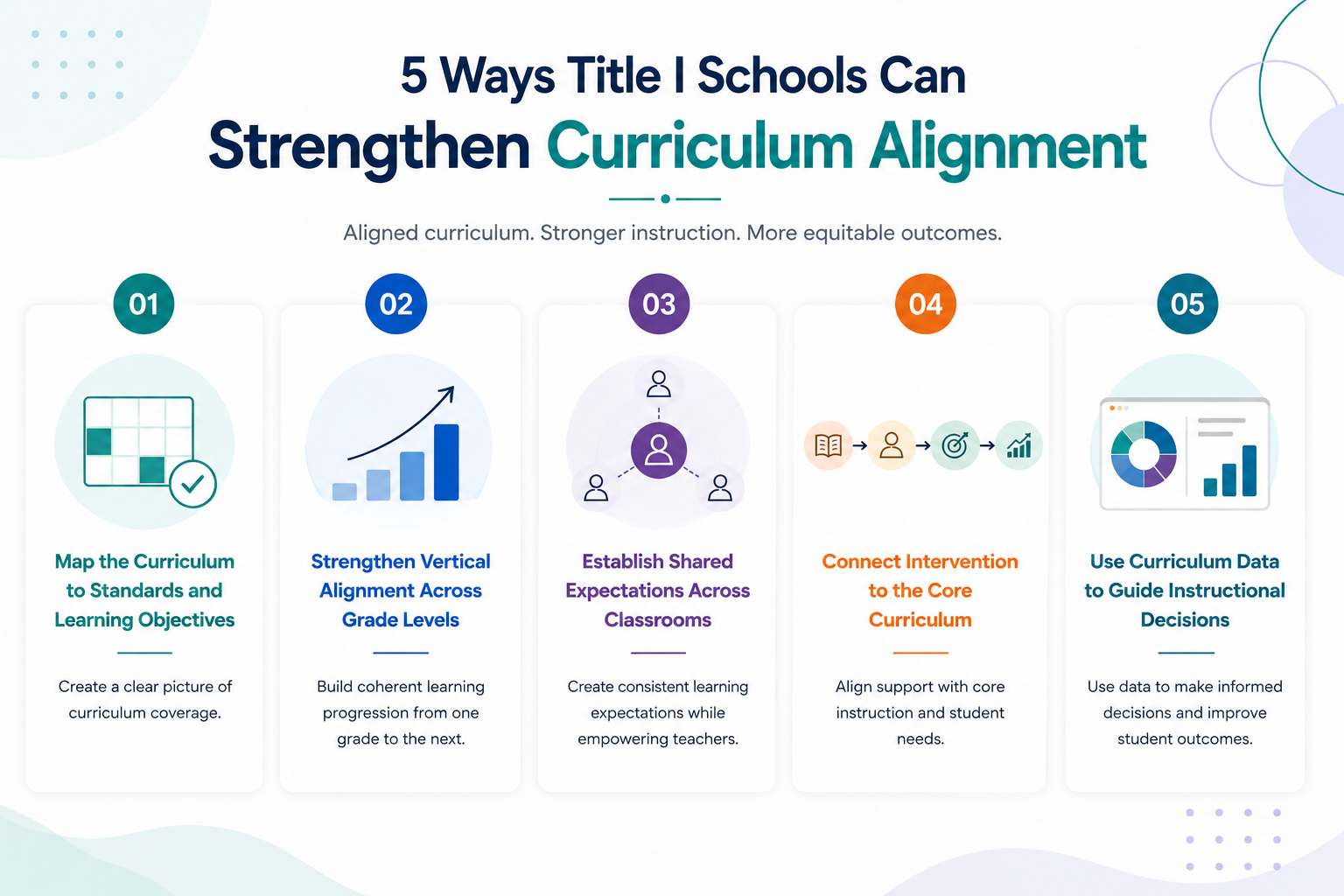
Strengthening alignment does not necessarily require schools to redesign their entire curriculum. A focused review of existing curriculum maps, standards, instructional practices and intervention strategies can reveal where improvements will have the greatest impact.
1. Map the Curriculum to Standards and Learning Objectives
Start by creating a clear picture of curriculum coverage. Curriculum mapping can help schools identify where standards are introduced, reinforced and developed across the learning sequence. The goal should go beyond checking whether a standard appears on a map. Leaders should also consider whether students have sufficient opportunities to develop and apply the knowledge and skills associated with that standard.
2. Strengthen Vertical Alignment Across Grade Levels
Teachers need visibility into the learning that comes before and after their own grade. Understanding prerequisite knowledge can help educators build instruction more intentionally and reduce gaps in student learning. Regular reviews of vertical curriculum maps can reveal:
- Missing prerequisite skills
- Unnecessary repetition
- Abrupt changes in rigor
- Standards receiving inconsistent attention
- Opportunities to strengthen learning progression
This is particularly valuable when schools are trying to build a consistent academic pathway across multiple grades.
3. Establish Shared Expectations Across Classrooms
Horizontal alignment can help schools create more consistent learning expectations when multiple teachers teach the same grade or subject. Consistency does not mean standardizing every lesson. Teachers should retain the professional autonomy to determine how they teach and differentiate instruction.
Instead, a shared curriculum framework ensures that students are working toward common essential learning goals.
4. Connect Intervention to the Core Curriculum
Additional academic support is most useful when it connects to what students are learning in the classroom. When classroom teachers, interventionists and curriculum leaders have access to shared curriculum expectations, they can better coordinate support around specific standards and skills.
A coherent approach can connect:
Grade-level standards → Core curriculum → Identified student needs → Intervention → Progress monitoring
This makes intervention part of a broader instructional strategy rather than a separate academic track.
5. Use Curriculum Data to Guide Instructional Decisions
Curriculum management becomes more valuable when curriculum information informs decisions. School leaders and teacher teams can review curriculum maps alongside student learning data to ask:
- Where are students consistently struggling?
- Were prerequisite skills addressed earlier?
- Is a standard receiving enough instructional attention?
- Are there differences in curriculum coverage between classrooms?
- Does intervention address the underlying learning need?
- Where might curriculum revision or professional learning be needed?
This moves curriculum mapping beyond documentation and toward continuous improvement.
The Role of PLCs in Curriculum Alignment
Professional learning communities can provide the collaborative structure needed to keep curriculum alignment active. When teachers have a shared view of curriculum expectations, PLC conversations can move beyond individual lessons toward learning progression and student outcomes. PLCs can use curriculum maps to examine questions such as:
- What should students know and be able to do?
- What should they already know?
- What evidence shows that they have learned it?
- Where are students struggling?
- Are there gaps in our curriculum sequence?
- What additional support is needed?
- How does current learning prepare students for the next grade?
A shared curriculum management system can give PLCs a common reference point for these conversations, helping connect curriculum planning, teacher collaboration, and instructional improvement.
How Curriculum Management Software Can Support Title I Schools
As schools manage more standards, curriculum resources, assessments, learning objectives and instructional documentation, maintaining curriculum visibility through disconnected spreadsheets and documents can become difficult. Curriculum management software can provide a centralized environment for organizing, reviewing and maintaining this information.
Depending on the platform, schools can use curriculum management software to:
- Create and maintain curriculum maps
- Connect curriculum to standards
- Review vertical and horizontal alignment
- Identify gaps and overlaps
- Support collaborative curriculum planning
- Give teachers and leaders a shared view of curriculum
- Review and update curriculum over time
The technology itself does not create alignment. The value comes from giving educators the visibility, structure and shared information they need to make better curriculum decisions.
How Edusfere Supports Curriculum Management and Curriculum Mapping
For schools looking to make curriculum alignment an ongoing practice, Edusfere provides a centralized approach to curriculum management and curriculum mapping. Instead of treating a curriculum map as a document that is created once and filed away, Edusfere helps schools make curriculum information accessible as part of everyday planning, collaboration and review.
Schools can use Edusfere to create greater visibility into curriculum, standards, and learning expectations while supporting both vertical and horizontal alignment. This gives teachers and curriculum leaders a shared foundation for examining how learning connects across grades, subjects and classrooms. That visibility can also strengthen curriculum conversations within PLCs and support a more consistent approach to curriculum planning and improvement.
The broader goal is simple: make curriculum easier for educators to understand, manage, collaborate around and continuously improve.
A Practical Curriculum Management Framework for Title I Schools
Schools can approach curriculum improvement as a continuous cycle rather than a one-time mapping project. A simple framework helps leaders move from understanding the current curriculum to making targeted improvements.
Audit → Map → Align → Collaborate → Monitor
Audit: Review the existing curriculum for gaps, overlaps, inconsistencies and areas of concern.
Map: Document what is taught, when it is taught and how standards and learning objectives are addressed.
Align: Strengthen vertical, horizontal and standards alignment.
Collaborate: Use PLCs and teacher teams to review curriculum alongside student learning evidence.
Monitor: Revisit curriculum maps and instructional priorities as student needs and school goals change.
This approach turns curriculum mapping from a compliance exercise into an ongoing part of curriculum management.
What Should Title I School Leaders Look for in a Curriculum Management System?
Choosing a curriculum management platform is ultimately an instructional decision, not simply a technology purchase. School leaders should consider whether a system can support the curriculum processes teachers and administrators actually need. Before selecting a platform, consider questions such as:
- Can teachers create and maintain curriculum maps efficiently?
- Can curriculum be aligned to relevant standards and learning objectives?
- Can leaders see curriculum across grades and subject areas?
- Does the system support vertical and horizontal alignment?
- Can teachers collaborate around curriculum and instruction?
- Can PLCs use shared curriculum information in their planning?
- Can leaders identify curriculum gaps and overlaps?
- Can curriculum be reviewed and updated as priorities change?
- Does the platform provide a clear schoolwide view of curriculum?
- Can the proposed investment be evaluated against applicable Title I requirements and local policies?
These questions help schools assess curriculum management software according to instructional priorities rather than simply looking for a digital place to store curriculum documents.
What Current Title I Updates Mean for School Leaders
Title I funding and implementation continue to evolve, making it important for school leaders to distinguish federal guidance from state and local implementation.
For FY2026, the U.S. Department of Education lists an estimated $18.43 billion in total Title I, Part A appropriations, with approximately $18.21 billion in new awards to states. The department notes that the FY2026 figures are estimates and that final allocations can be revised.
The Department also issued a January 2026 communication highlighting existing flexibility for states to encourage Title I schools using schoolwide programs to consolidate federal, state and local funds.
For schools planning curriculum-related investments, the practical takeaway is not that every curriculum tool is automatically an allowable Title I expense. Rather, leaders should connect proposed investments to their approved plans, program requirements and the specific needs the funding is intended to address.
For the most current information, school leaders can refer directly to the U.S. Department of Education's Title I, Part A funding and program information and NCES Title I Fast Facts.
Frequently Asked Questions About Title I, Curriculum Management and Curriculum Mapping
What is curriculum management in education?
Curriculum management is the ongoing process of planning, organizing, aligning, implementing, reviewing, and improving a school's curriculum. It helps educators maintain coherence between standards, learning objectives, instruction and curriculum across classrooms and grade levels.
What is curriculum mapping?
Curriculum mapping is the process of documenting what students are expected to learn, when concepts and standards are taught and how learning progresses over time. It helps schools identify curriculum gaps, overlaps and alignment issues.
Why is curriculum mapping important for Title I schools?
Curriculum mapping can help Title I schools identify inconsistencies in curriculum coverage and learning progression. It can also help educators connect additional academic support to the core curriculum and better understand where students may need additional instructional support.
How does curriculum management improve instructional equity?
Curriculum management can improve instructional equity by helping schools establish greater consistency in essential learning expectations. It gives educators visibility into curriculum across classrooms and grade levels, making it easier to identify gaps and strengthen students' access to a coherent learning pathway.
What is the difference between vertical and horizontal curriculum alignment?
Vertical alignment focuses on how learning progresses from one grade level to another. Horizontal alignment focuses on consistency in curriculum expectations across classrooms or teachers within the same grade or subject. Both contribute to a more coherent curriculum.
How can PLCs support curriculum alignment?
PLCs can use curriculum maps to examine standards, learning progression, student performance and instructional gaps. Shared curriculum information gives teacher teams a common starting point for coordinating instruction and determining how to respond to student needs.
Can curriculum management software support curriculum mapping?
Yes. Curriculum management software can provide a centralized environment for creating, organizing, reviewing and maintaining curriculum maps. Depending on the platform, it can also support standards alignment, curriculum analysis, collaboration and vertical and horizontal alignment.
How does Edusfere support curriculum management?
Edusfere provides a centralized approach to curriculum management and curriculum mapping, helping schools organize curriculum information and improve visibility across grades, subjects and classrooms. This can support curriculum planning, collaboration, alignment and ongoing curriculum improvement.
Can Title I funds be used for curriculum management software?
There is no universal answer. Allowable uses depend on the specific Title I program, the school's circumstances, applicable federal requirements and state and local policies. Schools should consult their state or local education agency before using Title I funds for a specific curriculum management investment.
How should a school begin improving curriculum alignment?
A practical starting point is to audit, map, align, collaborate and monitor. Review the current curriculum, map standards and learning expectations, identify gaps and overlaps, strengthen vertical and horizontal alignment and establish a process for regular review with teachers and PLCs.
Build a More Coherent Curriculum With Edusfere
Creating an aligned curriculum is easier when educators have a shared view of what is being taught, how learning progresses and where improvements are needed. Edusfere brings curriculum management and curriculum mapping into one connected environment, helping schools make curriculum more visible, collaborative, and actionable.
Explore how Edusfere can help your school strengthen curriculum alignment, support educators and build a more coherent learning experience for every student.