

Accreditors and accreditation reviews increasingly evaluate how well schools align curriculum, instruction, assessment and governance over time; not just whether documentation exists.
Inside This Blog:
- Why Accreditation-Ready Curriculum Management Matters for U.S. Schools
- Common Curriculum accreditation Gaps Without a Curriculum Management Tool
- What Continuous Curriculum Mapping Means in Practice
- How Edusfere Aligns with Accreditation Expectations from WASC, Cognia and ACSI
- Curriculum Alignment to Standards
- Consistency Between Written and Taught Curriculum
- Assessment Alignment and Evidence of Learning
- Curriculum Review, Improvement and Change Management
- Leadership Oversight and Curriculum Governance
- How Edusfere’s Curriculum Mapping Software Keeps Schools accreditation-ready
- Accreditation-ready Curriculum Checklist for Schools Using Curriculum Mapping Software
- What an accreditation Looks Like with an accreditation-ready Curriculum Management Tool
- Best Practices for Sustainable Implementation
- Frequently Asked Questions (FAQ) about Curriculum Mapping and Curriculum Management Tools
- Building Accreditation-Ready Schools with Curriculum Mapping Software
As a modern curriculum management tool, Edusfere enables U.S. schools to move from reactive accreditation preparation to proactive instructional confidence. And today’s blog acts as a guide designed for school leaders, curriculum directors, instructional coaches and district teams evaluating curriculum mapping software and curriculum management tools for accreditation-readiness.
Why Accreditation-Ready Curriculum Management Matters for U.S. Schools
Across the United States, accreditation visits now extend well beyond compliance checklists. State departments of education, district reviewers and accreditation bodies expect schools to demonstrate:
- Standards-aligned curriculum design
- Consistent instructional delivery across classrooms
- Valid and aligned assessments
- Evidence of student learning
- Clear leadership oversight and review processes
The challenge for many schools is not commitment, it is fragmentation. Curriculum documents live in one place, lesson plans in another, assessments in an LMS and evidence scattered across drives and emails. During accreditation visits, this fragmentation becomes visible.
Edusfere addresses this challenge by centralizing curriculum work into a single, continuously updated system.
Common Curriculum Gaps Without a Curriculum Management Tool
Based on common accreditation findings, schools often struggle with:
- Inconsistent curriculum structures across grades or departments
- Limited visibility into standards coverage
- Difficulty proving that documented curriculum is actually taught
- Missing or disconnected assessment evidence
- Unclear curriculum review and approval processes
These gaps are rarely intentional but they are exactly what accreditation visits surface. Continuous curriculum mapping helps schools close them before they become findings.
What Continuous Curriculum Mapping Means in Practice
Continuous curriculum mapping is not about adding paperwork. It is about maintaining instructional clarity and alignment over time. Using Edusfere’s curriculum mapping software, continuous mapping means:
- Curriculum maps are updated as instruction evolves
- Standards alignment is reviewed regularly, not once a year
- Assessments are clearly tied to learning objectives
- Evidence is captured as teaching happens
- Leadership has real-time visibility into curriculum quality
This approach ensures that accreditation readiness becomes an outcome of daily practice, not a special project.
How Edusfere Aligns with Accreditation Expectations from WASC, Cognia and ACSI
While accreditation frameworks differ in structure and terminology, accrediting bodies consistently evaluate whether curriculum operates as a coherent, well-governed instructional system. Edusfere’s curriculum mapping workflows are intentionally designed to support these shared expectations.
Below is how Edusfere aligns with the curriculum-focused review criteria commonly applied by accreditation bodies like WASC, Cognia and ACSI.
Curriculum Alignment to Standards
What accreditors expect: Accreditation teams look for evidence that curriculum is aligned to approved standards and articulated clearly across grade levels and subjects.
How Edusfere supports this: Edusfere enables schools to map standards at both unit and lesson levels, providing clear visibility into where and how each standard is taught across the academic year. This supports horizontal and vertical alignment, an expectation emphasized across WASC, Cognia and ACSI reviews.
Consistency Between Written and Taught Curriculum
What accreditors expect: Schools must demonstrate that classroom instruction reflects the documented curriculum, not informal or parallel plans.
How Edusfere supports this: Instructional plans and resources are directly linked to curriculum objectives within Edusfere. This allows schools to show that daily teaching aligns with the written curriculum, supporting instructional coherence across classrooms and sections.
Assessment Alignment and Evidence of Learning
What accreditors expect: Accreditors evaluate whether assessments meaningfully measure stated learning outcomes and standards.
How Edusfere supports this: Edusfere allows formative and summative assessments to be aligned directly to standards and objectives, with rubrics and performance criteria documented. Evidence of learning can be attached in context, helping schools demonstrate how student learning is evaluated and supported.
Curriculum Review, Improvement and Change Management
What accreditors expect: Accreditation bodies do not expect curriculum to remain static. They look for documented processes that show how curriculum is reviewed, updated and improved over time.
How Edusfere supports this: Edusfere maintains version history for curriculum updates, capturing what changed, when it changed, and who made the update. This demonstrates intentional improvement rather than reactive, last-minute revisions.
Leadership Oversight and Curriculum Governance
What accreditors expect: Review teams assess whether school leadership actively oversees curriculum quality through defined review and approval processes.
How Edusfere supports this: Role-based access, review workflows and visible approval logs within Edusfere provide clear evidence of instructional leadership involvement and accountability, an important indicator across all three accreditation frameworks.
Why this alignment matters
By supporting these shared accreditation expectations, Edusfere enables schools to demonstrate readiness as part of normal instructional practice. Curriculum alignment, evidence, review and governance are continuously maintained, allowing schools to engage in accreditation reviews with clarity and confidence, rather than last-minute preparation.
See how schools are simplifying alignment without adding teacher workload.
Book a live Edusfere walkthrough to explore real dashboards, reporting workflows and accreditation-ready curriculum views in action.
How Edusfere’s Curriculum Mapping Software Keeps Schools accreditation-ready
Step 1: Building a Standards-aligned Curriculum Map with Curriculum Mapping Software
Accreditation question answered: “Is your curriculum aligned to approved standards?”
Schools begin by creating curriculum maps within Edusfere at the course, grade or subject level. Each map follows a consistent structure and includes:
- Unit goals and pacing guidance
- Clearly defined learning objectives
- Aligned state or district standards
- Planned formative and summative assessments
- Core instructional resources
As a curriculum management tool, Edusfere standardizes curriculum documentation across classrooms, something accreditation teams immediately notice.
Step 2: Connecting Instruction Using a Curriculum Management Tool
Accreditation question answered: “How do you know the curriculum is actually being taught?”
Teachers link lesson plans, instructional activities and learning resources directly to mapped objectives within Edusfere. This creates a clear connection between curriculum intent and classroom instruction. Rather than collecting lesson plans during an accreditation , schools can demonstrate instructional alignment in real time.
Step 3: Linking Assessments and Evidence in Curriculum Mapping Software
Accreditation question answered: “How do you measure and verify student learning?”
Within Edusfere’s curriculum mapping software, schools connect:
- Assessment tools and rubrics
- Performance tasks and quizzes
- Formative checks
- Samples of anonymized student work
This allows accreditation teams to trace learning outcomes from standards to assessment to evidence without leaving the curriculum map.
Step 4: Managing Curriculum Updates with a Curriculum Management Tool
Accreditation question answered: “How do you manage curriculum updates?”
Curriculum evolves; and accreditation teams understand that. What matters is transparency. Edusfere automatically records:
- Who made a change
- What was updated
- When it occurred
- Why the change was made
This version history demonstrates intentional improvement rather than last-minute compliance edits.
Step 5: Curriculum Review and Governance Using a Curriculum Management Tool
Accreditation question answered: “Who oversees curriculum quality?”
Edusfere enables structured curriculum governance through:
- Role-based access and permissions
- Department and grade-level reviews
- Instructional coach feedback
- Administrative approvals with timestamps
These workflows provide clear evidence of leadership oversight, an area accreditation teams scrutinize closely.
Step 6: Monitoring Standards Coverage with Curriculum Mapping Software
Accreditation question answered: “Are all standards adequately covered?”
Edusfere’s dashboards help leaders:
- View standards coverage by grade and subject
- Identify under- or over-taught standards
- Adjust pacing and instruction proactively
This prevents misalignment issues from surfacing during accreditations.
In accreditation-ready U.S. schools, curriculum mapping is a shared responsibility with clearly defined ownership. Teachers are responsible for maintaining accurate lesson-level alignment and attaching instructional evidence. Instructional coaches review curriculum maps for coherence, pacing and assessment alignment. Department heads and principals oversee consistency across grades and subjects, while district curriculum leaders monitor standards coverage and governance processes.
Edusfere’s curriculum management tool supports this distributed ownership model by providing role-based access, review workflows, and visibility at every level. This ensures accountability without adding administrative burden and gives accreditors confidence that curriculum quality is actively managed, not assumed.
Accreditation-Ready Curriculum Checklist for Schools Using Curriculum Mapping Software
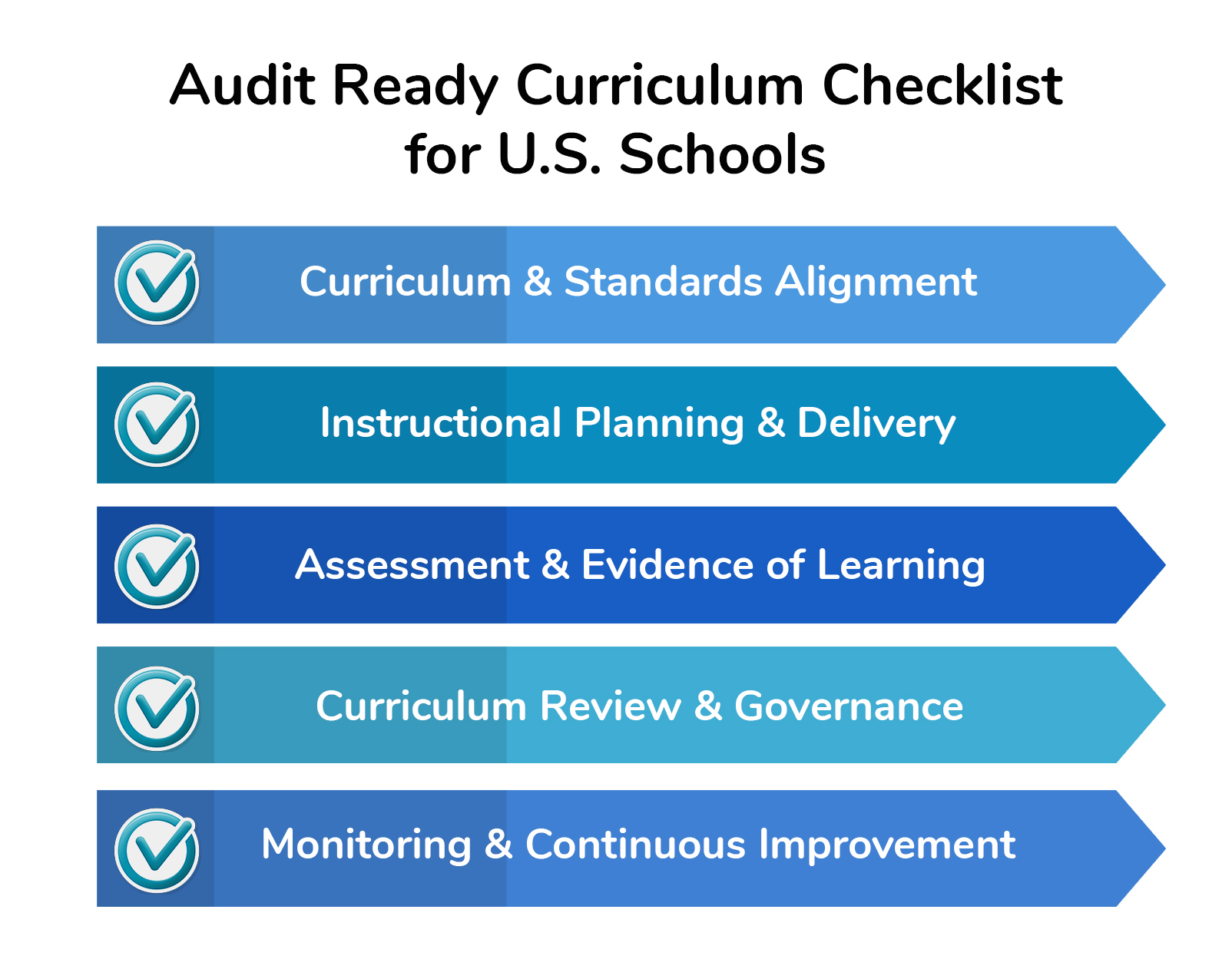
- Standards mapped at unit and lesson levels
In accreditation-ready schools, standards are not mapped only at the course level. Each standard is intentionally connected to specific units and individual lessons, showing when, where, and how it is taught across the year.
For accreditation ors, this provides clear evidence of instructional intent and coverage, allowing them to trace standards directly into classroom-level instruction rather than relying on generalized curriculum statements.
- Instructional plans linked to curriculum objectives
Instructional plans such as lesson outlines, activities and resources are directly linked to the curriculum’s stated learning objectives. This ensures that daily teaching reflects the documented curriculum. During accreditation s, this linkage helps schools demonstrate that the written curriculum and the taught curriculum are aligned, consistent and intentionally designed across classrooms.
- Assessments aligned to standards
Assessments are explicitly mapped to the standards and objectives they are designed to measure. This includes both formative checks and summative evaluations, supported by aligned rubrics or performance criteria.
Accreditors look for this alignment to confirm that student learning is evaluated against clearly defined expectations, rather than informal or disconnected measures.
- Evidence attached in context
Instructional and assessment evidence such as lesson artifacts, assessment samples or anonymized student work is stored alongside the specific unit, lesson or standard it supports. This contextual placement allows accreditation ors to immediately understand why the evidence exists and what it demonstrates, reducing ambiguity and follow-up questions during reviews.
- Version history documented
Curriculum updates are tracked over time, capturing what changed, when it changed, and who made the update. accreditation ors do not expect curriculum to remain static; they expect intentional change management. Documented version history shows that updates are part of an ongoing improvement process, not reactive edits made for compliance.
- Review and approval logs visible
Curriculum maps and updates pass through defined review and approval processes involving instructional leaders and administrators. These reviews are documented with timestamps and comments.
For accreditation visits, visible approval logs demonstrate leadership oversight, accountability and curriculum governance – key indicators of a well-managed instructional system.
Download the accreditation-ready Curriculum Checklist– A one-page guide for school leaders to assess curriculum alignment, evidence and accreditation readiness, updated for U.S. schools.
Schools using Edusfere typically meet these criteria continuously, not just during the accreditation season.
What Accreditation Looks Like with an accreditation-ready Curriculum Management Tool
When accreditors request documentation, school leaders can:
- Open live curriculum maps
- Demonstrate standards alignment visually
- Show linked instruction and assessments
- Share approval logs and review notes
- Export accreditation-ready reports instantly
The accreditation becomes a confirmation of strong systems, not a search for missing documents.
Best Practices for Sustainable Implementation
To maximize the value of Edusfere’s curriculum management tool, schools should:
- Define clear expectations for curriculum completeness
Schools should establish a shared definition of what a “complete” curriculum map includes. This typically covers unit objectives, aligned standards, instructional plans, assessments and supporting resources. Clear expectations help ensure consistency across grades and departments and reduce confusion about what is required.
When expectations are documented and communicated upfront, curriculum updates become easier to maintain and review over time.
- Train teachers in short, role-based sessions
Effective implementation does not require long, one-size-fits-all training. Instead, schools benefit from brief, role-specific sessions tailored to teachers, instructional coaches and administrators. Teachers focus on updating lesson-level alignment and attaching evidence, while leaders focus on review workflows and standards coverage.
This approach respects educators’ time and improves adoption.
- Embed mapping into planning and PLC time
Curriculum mapping is most sustainable when it is integrated into existing planning routines rather than treated as an additional task. Schools should align curriculum updates with lesson planning cycles and professional learning community (PLC) meetings.
When mapping becomes part of normal instructional conversations, it remains current and relevant throughout the year.
- Schedule regular curriculum reviews
Rather than waiting for accreditation s or accreditation cycles, schools should establish regular curriculum review checkpoints, monthly or once per term. These reviews allow teams to confirm alignment, address gaps and document improvements while instructional decisions are still timely.
Regular review cycles reinforce accountability and reduce last-minute preparation.
- Use analytics to guide instructional improvement
For schools preparing for upcoming accreditation s or accreditation visits, this checklist also serves as a readiness playbook. Leadership teams can review each item quarterly, using Edusfere’s dashboards to confirm alignment and evidence coverage. Any gaps identified can be addressed immediately, long before an external review begins.
Over time, this routine builds a culture where accreditation readiness is maintained continuously, not reactively.
Frequently Asked Questions (FAQ) about Curriculum Mapping and Curriculum Management Tools
- What is curriculum mapping software and why do accreditors value it?
Curriculum mapping software documents alignment between standards, instruction, assessment, and evidence. Accreditors value it because it provides transparent, verifiable proof of instructional quality.
- How does a curriculum management tool differ from an LMS?
A curriculum management tool governs curriculum design, alignment and review. An LMS delivers instruction to students. Edusfere complements LMS platforms by managing the curriculum layer.
- Can Edusfere support state-specific standards?
Yes. Edusfere allows schools to configure and map curriculum to state and district standards used across the U.S.
- How often should curriculum maps be reviewed?
Continuously, with formal reviews at least once per term. Edusfere simplifies both ongoing updates and structured reviews.
- Can Edusfere generate accreditation-ready reports?
Yes. Schools can generate standards coverage reports, curriculum maps, approval logs and evidence summaries suitable for accreditation visits.
Building accreditation-ready Schools with Curriculum Mapping Software
Accreditation-readiness should reflect the strength of a school’s instructional systems, not its ability to assemble documents under pressure. With Edusfere’s curriculum mapping software and integrated curriculum management tool, U.S. schools embed alignment, evidence and accountability into everyday practice.
When accreditors arrive, schools don’t scramble. They demonstrate!
Book a personalised Edusfere demo to see how outcomes alignment can become a seamless, school-wide process.