
Key Takeaways
- ACSI, WASC and Cognia all require documented curriculum evidence across standards alignment, grade-level coherence and a traceable improvement process. Good teaching without documentation does not pass a review.
- Curriculum mapping should not just be an accreditation preparation task. Schools that treat it as year-round practice arrive at reviews ready. Schools that don't, scramble.
- ACSI's Inspire protocol requires biblical worldview integration to be visible in curriculum design, not just stated in a mission document.
- WASC's Focus on Learning framework demands cross-subject, cross-grade coherence that only a school-wide curriculum map can make visible to an external team.
- Cognia's IEQ scores schools on whether curriculum alignment is embedded in daily practice. The difference between "Initiate" and "Impact" levels is largely a documentation gap.
- Staff turnover erases institutional curriculum knowledge. A centralised curriculum management system ensures what was built stays, regardless of who leaves.
Most schools that struggle during accreditation reviews are not struggling because of bad teaching. They are struggling because they cannot show what is happening in their classrooms across grades, across subjects, across the school year. That is a curriculum documentation problem. And it is the exact problem that structured curriculum mapping solves.
Whether your school is pursuing accreditation through ACSI, ACS WASC or Cognia, the evidence each body asks for including standards alignment, instructional coherence, documented improvement, maps directly onto what a curriculum management system produces as a matter of daily practice. This guide explains exactly how.
What Accreditation Bodies Are Actually Looking For
Before comparing bodies, it helps to understand what all three have in common. At their core, ACSI, WASC and Cognia are not asking whether your teachers are good. They are asking whether your school can demonstrate that learning is intentional, coherent and improving. This distinction matters because it reframes accreditation from a credentialing exercise into an infrastructure problem. Schools that pass reviews well are not schools that prepared the best binders. They are schools that already had their curriculum evidence organised because they run that way year-round.
Here is what each body specifically requires and where curriculum mapping intersects.
ACSI: Curriculum as a Reflection of Mission
ACSI's Inspire protocol evaluates schools across four strands: biblical worldview integration, academic excellence, student development and organisational effectiveness. Two of those four strands, i.e., academic excellence and organisational effectiveness, depend heavily on documented curriculum evidence.
Academic excellence requires that a school demonstrate its instructional program is deliberately designed, standards-aligned and produces measurable outcomes. Organizational effectiveness asks whether the systems behind instruction are sustainable, not reliant on institutional memory held by individual teachers but embedded in school-wide processes.
For faith-based schools, there is an additional layer – the curriculum must visibly reflect a Christian philosophy of education. Visiting teams want to see that biblical worldview integration is not a mission statement phrase, it is traceable in how units are designed and how learning is sequenced. What curriculum mapping provides here is a structured, reviewable record of both. A well-built curriculum map shows reviewers what is taught, when it is taught, how it connects to standards and for ACSI schools, where the school's stated worldview appears in instructional design.
That is evidence that a conversation cannot produce; only documentation can.
WASC: Evidence That Learning Is Intentional and Schoolwide
ACS WASC's Focus on Learning framework is built around three non-negotiable components, i.e., schoolwide learner outcomes that every stakeholder understands, evidence-based interdisciplinary dialogue about what students are actually producing and a schoolwide action plan grounded in that evidence. The phrase "schoolwide" is doing a lot of work in that framework. A visiting committee is not satisfied with strong individual classrooms. They want to see whether coherence exists across classrooms. That is, whether a Grade 5 ELA teacher and a Grade 5 Science teacher are working from the same framework for what a skilled student communicator looks like by end of year.
That kind of coherence does not emerge spontaneously. It is built through curriculum mapping. It is the structured process of documenting what is taught across every grade and subject, aligning it to shared outcomes and making those connections visible to everyone, including an external review team.
Cognia: Performance Standards Built Around Curriculum Coherence
Cognia's Performance Standards are the most explicit of the three about curriculum documentation. Standard 12 directly states that professional staff must implement curriculum and instruction that are “aligned for relevancy and effectiveness for each and every learner”. Standard 13 addresses whether curriculum is appropriate to the needs of learners and adjusted through data. Standards 14 and 15 address qualified personnel implementing the curriculum effectively.
These are not soft criteria. Cognia's Index of Education Quality (IEQ) , scored on a scale of 100 to 400, translates these standards into a formative benchmark. The implications for curriculum mapping are direct. Cognia reviewers are not looking for a curriculum binder produced three weeks before the visit. They are looking for evidence that curriculum management is a living system, that teachers regularly reference aligned maps, that pacing is monitored, that gaps are identified and addressed. That is what the IEQ is measuring.
Where Schools Go Wrong: The Four Documentation Gaps
Across all three frameworks, review teams consistently flag the same four failure points. None of them are about instruction quality.
The alignment gap
Teachers are teaching to the standards but there is no centralised, searchable record of which standards are covered, when and by whom. Reviewers cannot validate alignment they cannot see.
The coherence gap
Strong unit plans exist at the classroom level but there is no school-wide map showing how learning builds from grade to grade. A Grade 7 student's readiness for Grade 8 cannot be verified because vertical alignment was never documented.
The continuity gap
When experienced teachers leave, their curriculum knowledge leaves with them. Schools with high turnover cannot demonstrate the institutional stability that accreditation bodies look for across a multi-year review cycle.
The evidence gap
Schools know what outcomes they want for students but cannot trace the connection between instructional design and those outcomes in any auditable way.
Each of these gaps is a curriculum management failure; and each is directly addressable through the right systems.
How Curriculum Mapping Closes Each Gap Before the Review Team Arrives
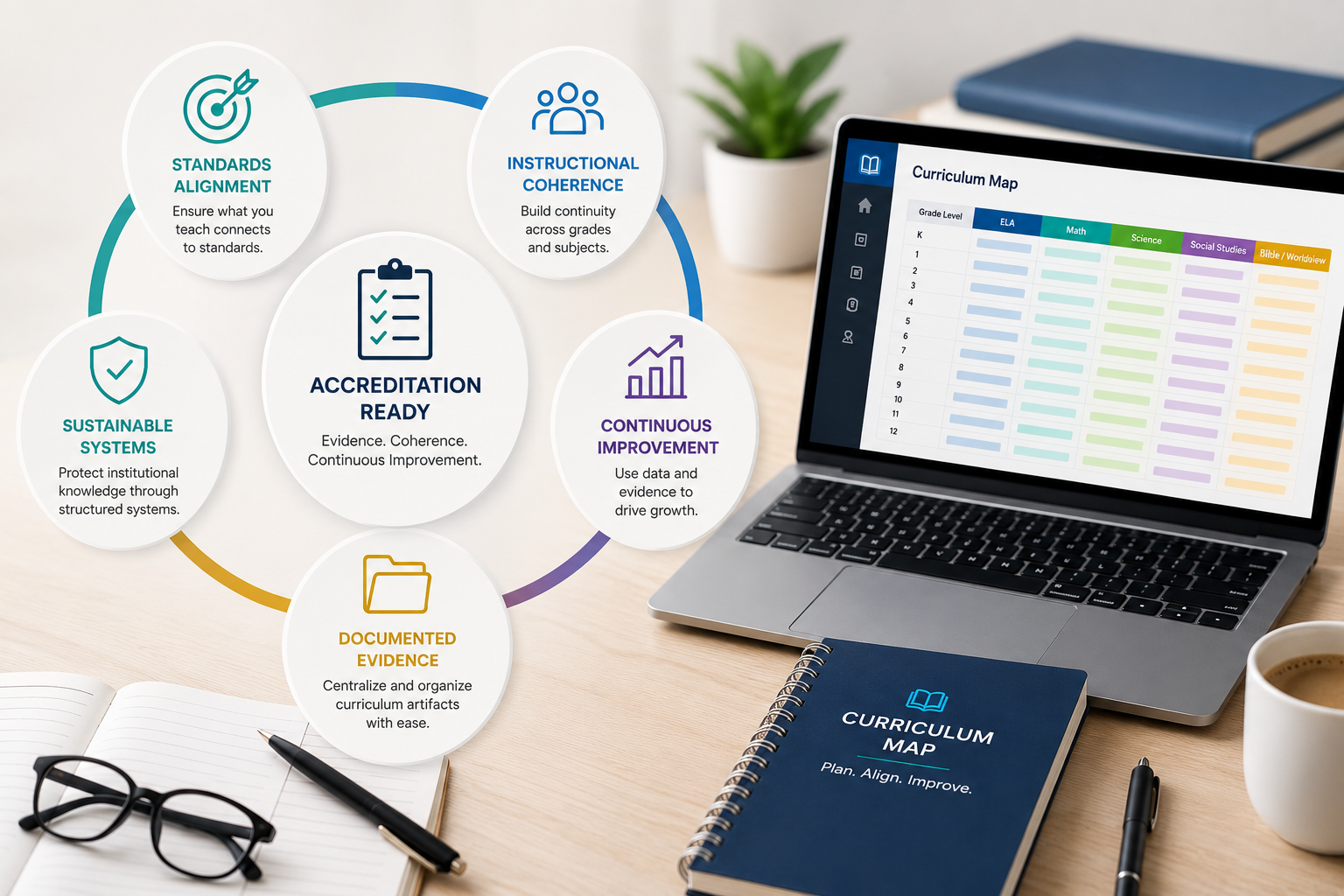
Curriculum mapping is the practice of systematically documenting what is taught across every grade and subject: the standards addressed, the sequence of learning, the assessments used and the connections between units. When it is done consistently and stored in a centralized platform, it produces exactly the evidence each accrediting body is looking for.
Standards alignment becomes searchable
Instead of asking teachers to produce evidence of standards coverage during a review, administrators can generate an alignment report across all courses in minutes. ACSI reviewers, WASC visiting committees and Cognia engagement teams can see documented alignment instantly.
Vertical coherence becomes visible
A curriculum map that spans Grade 1 through Grade 12 within a subject shows precisely how skills and knowledge build year by year. This is the kind of evidence that moves a school from Cognia's "Initiate" level toward "Impact."
Institutional knowledge is preserved
When curriculum lives in a shared platform rather than individual teachers' folders, teacher turnover does not erase it. New staff inherit a documented curriculum, not a blank page.
Improvement is traceable
Version history and pacing data create an auditable trail of how the curriculum has evolved in response to student outcomes, professional learning and stakeholder feedback, the continuous improvement evidence every accreditation cycle requires.
This is where Edusfere is built to help. Edusfere gives school leaders and curriculum coordinators a centralized workspace to build, maintain and align curriculum maps across every grade and subject. Standards tagging, pacing tools, collaborative planning and exportable reports mean that accreditation evidence is not assembled under pressure. Rather, it exists because the school already runs that way.
Schools using Edusfere do not prepare for accreditation. They arrive at it ready.
Frequently Asked Questions
What is curriculum mapping in K-12 education?
Curriculum mapping is the process of documenting what is taught across every grade and subject; the standards addressed, the sequence of learning, the assessments used and how units connect across the school year. In K-12 schools, it creates a shared, school-wide record that makes instructional decisions visible, coherent and improvable over time.
How does curriculum mapping help schools prepare for accreditation?
Curriculum mapping produces the exact evidence accreditation reviewers look for: documented standards alignment, visible coherence across grade levels and a traceable record of how instruction has improved over time. Schools with structured curriculum management in place can retrieve this evidence on demand rather than reconstruct it under review pressure.
What curriculum evidence do ACSI, WASC and Cognia reviewers look for?
All three bodies require proof that the curriculum is standards-aligned, coherent across grades and subjects and connected to a continuous improvement process. ACSI additionally requires evidence that biblical worldview integration is visible in curriculum design. WASC requires cross-subject coherence tied to schoolwide learner outcomes. Cognia's Performance Standard 12 explicitly requires curriculum aligned for relevancy and effectiveness for each and every learner.
What is the difference between ACSI, WASC and Cognia accreditation?
ACSI is designed exclusively for Christian faith-based K-12 schools. ACS WASC serves public and independent schools in California, Hawaii, the Pacific and international schools offering U.S.-aligned curricula. Cognia is the largest accrediting body in the world, serving over 40,000 institutions across 100+ countries and is appropriate for any school type. All three use a continuous improvement framework but differ in their standards, review processes and ideal-fit institutions.
What is Cognia's Index of Education Quality (IEQ) and how is it scored?
The IEQ is Cognia's school performance benchmark, scored on a scale of 100 to 400 across three domains including Leadership Capacity, Learning Capacity, and Resource Capacity. Schools scoring below 250 are at the "Initiate" level, indicating foundational gaps in areas like curriculum alignment. Schools progressing toward "Improve" and "Impact" levels are those where alignment is documented, consistently used and visibly driving instructional decisions.
Does curriculum mapping software help with K-12 accreditation?
Yes. Curriculum mapping software centralises standards alignment, pacing and instructional documentation in one place. This further makes the evidence accreditation bodies require, retrievable rather than reconstructed. Schools using a curriculum management platform can generate alignment reports, track coverage gaps and produce version histories that demonstrate continuous improvement, which directly addresses the review criteria of ACSI, WASC and Cognia.
How long does the K-12 accreditation process take?
Cognia's initial accreditation can typically be completed in approximately six months. ACS WASC involves a candidacy period of up to three years before full accreditation is granted. ACSI's timeline depends on a school's starting readiness but typically spans multiple years. Schools with documented curriculum management already in place move through the self-study phase, the most time-intensive component of any process significantly faster.
Which Accreditation Body Should You Choose?
Accreditation body selection depends on your school's mission, geography and student population, not on which process is easiest.
Consider ACSI if your school's identity is explicitly grounded in a Christian philosophy of education and you need a framework that evaluates how that worldview is embedded in curriculum and culture.
Consider choosing ACS WASC if you are a public or independent school in California, Hawaii or the Pacific or an international school offering a U.S.-aligned curriculum to students who will apply to UC or CSU institutions.
Consider Cognia if you need the broadest global recognition, serve a public school district or want a data-benchmarked continuous improvement framework with the widest international credibility across 100+ countries.
All three will ask the same fundamental question during your review, i.e., can you show us that your curriculum is intentional, coherent and improving? Curriculum mapping is how you answer yes, with evidence.
Edusfere is a K-12 curriculum mapping and management platform built to help school leaders, curriculum coordinators, and teachers plan, align and document curriculum that meets the standards of any accrediting body.
Schedule a demo with the Edusfere team today!
Reviewed by: Grant Wootten, Founder & CEO, Edusfere.