

Key Takeaways
- The biggest implementation costs often come after software purchase.
- Curriculum migration frequently becomes a curriculum review exercise.
- Governance and administrative planning are critical for adoption.
- Teacher onboarding requires ongoing support, not just initial training.
- Schools should evaluate implementation services alongside platform features.
When schools evaluate curriculum management software, most conversations focus on features, pricing, integrations and reporting capabilities. Can the platform support standards mapping? Does it provide curriculum alignment reports? How easy is it for teachers to use? These are important questions but they rarely tell the whole story.
In reality, the success of a curriculum management initiative is often determined long before teachers begin using the platform. Curriculum migration, governance decisions, staff adoption, accreditation requirements and ongoing support all play a significant role in whether a school realizes value from its investment.
This is why two schools can purchase similar curriculum management software and experience completely different outcomes. One school achieves stronger curriculum alignment, improved collaboration and streamlined accreditation preparation. The other struggles with inconsistent adoption, incomplete curriculum documentation and limited long-term engagement. The difference is rarely the software alone. More often, it comes down to how implementation is planned, supported and sustained.
For school leaders evaluating curriculum management systems, understanding these hidden costs can help avoid common pitfalls, ask better questions during vendor evaluations and make more informed purchasing decisions.
Looking Beyond Licensing Fees: The Real Cost of Curriculum Management Implementation
The visible costs of curriculum management software are easy to identify. Schools can compare subscription fees, implementation packages and support plans during the procurement process. The less visible costs often emerge after the contract is signed.
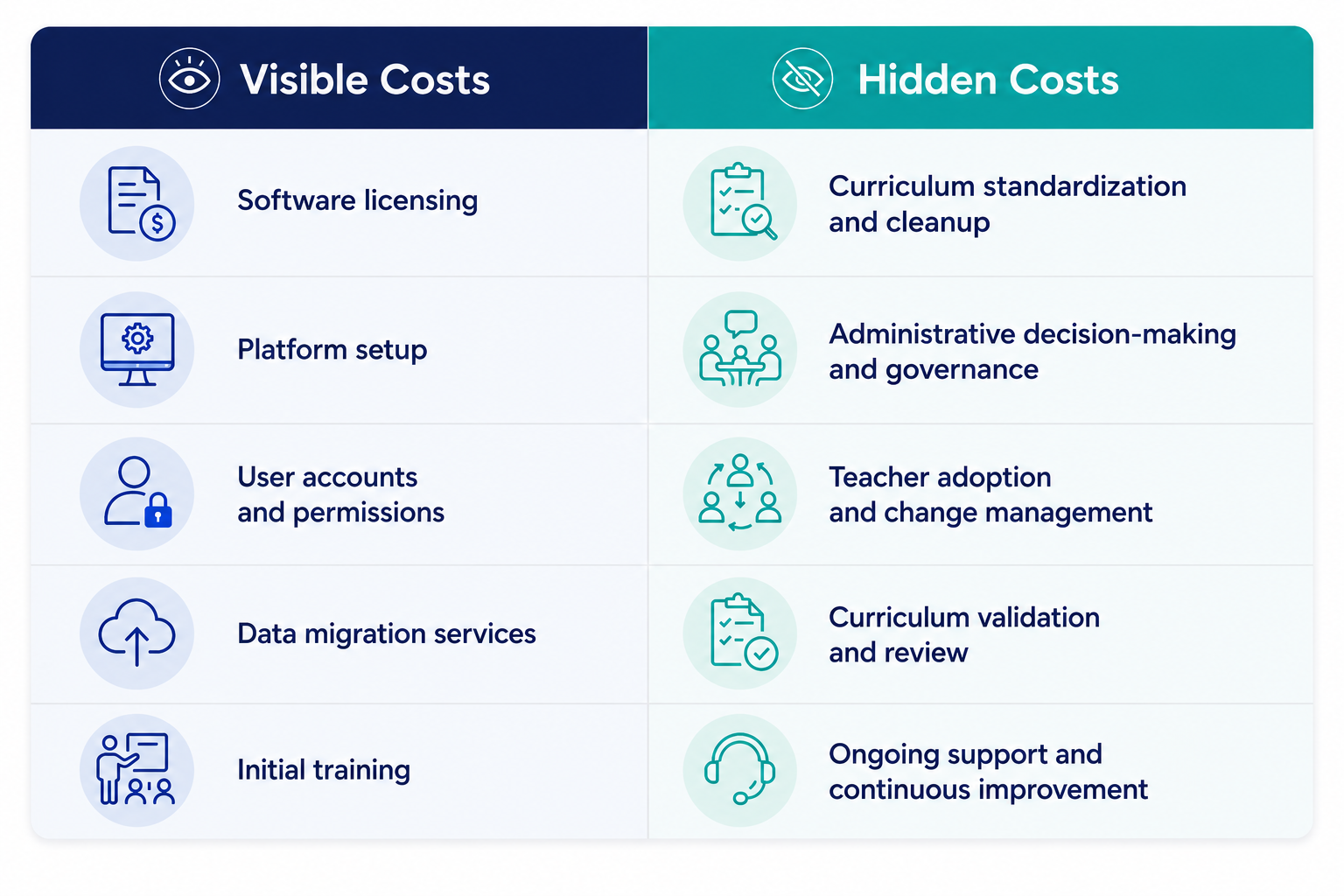
These hidden costs are not necessarily negative. In fact, many of them lead to stronger curriculum practices. The challenge is that schools often underestimate the time, resources and leadership attention required to address them.
Curriculum Migration Is Often a Curriculum Audit
One of the most common misconceptions about implementing curriculum mapping software is that migration is primarily a technical process. Schools frequently assume that curriculum data can simply be exported from one platform and imported into another. In practice, migration often becomes a curriculum review exercise.
Curriculum information is rarely stored in a single location. Schools may have course maps in spreadsheets, unit plans in shared drives, assessment documentation in learning management systems and standards information maintained separately by curriculum teams. Over time, documentation practices can vary significantly across grade levels and departments.
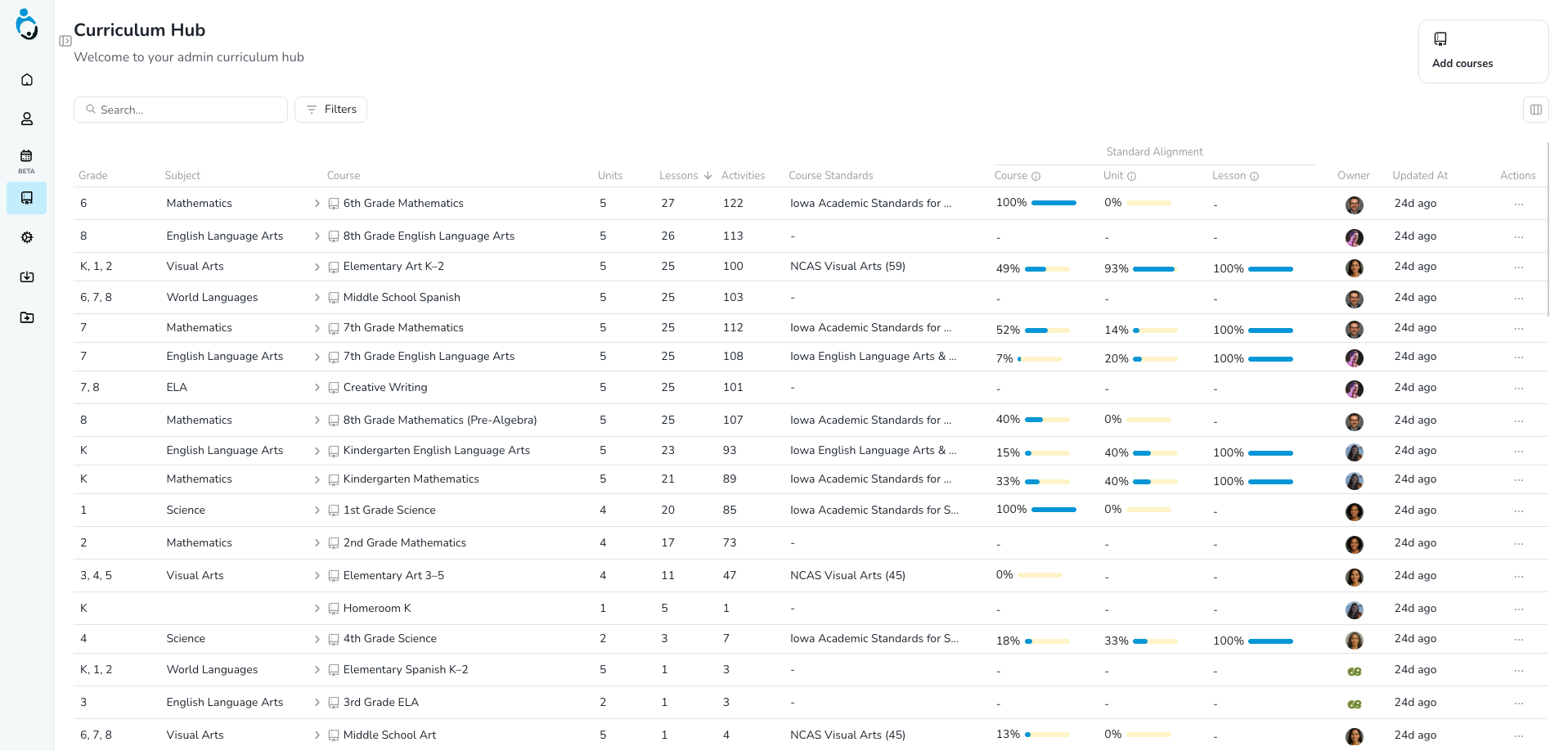
Figure 1. A centralized curriculum view can help administrators review course structures, standards alignments, and curriculum organization before migration and implementation.
As schools prepare to migrate information into a new curriculum management system, they often need to answer questions such as:
- Which courses should remain active and visible to staff?
- Which archived courses should be preserved for future reference?
- Are standards aligned consistently across departments?
- Are curriculum maps complete and up to date?
- Who will be responsible for maintaining curriculum documentation moving forward?
These conversations are valuable because they create greater curriculum clarity. However, they also require time from academic leaders, department heads and administrators.
Schools evaluating curriculum management software should ask vendors not only how data migration works but also what level of support is available throughout the migration process and what responsibilities remain with school staff. Some vendors assist with migrating course and unit structures from existing systems, while others expect schools to manage the process independently.
Governance Decisions Often Take Longer Than Technical Setup
Many school leaders assume the primary implementation challenge will be training teachers. In reality, some of the most important work happens before teacher onboarding begins.
A curriculum management platform requires schools to formalize decisions that may previously have been handled informally. Questions around curriculum ownership, review cycles, documentation standards, approval workflows and standards alignment suddenly become much more visible once information is centralized.
Administrative teams often use curriculum management systems to establish governance structures, curriculum ownership, standards frameworks and review workflows before broader teacher onboarding begins.
Leadership teams may need to determine who approves curriculum updates, how often curriculum maps should be reviewed, what documentation expectations exist for teachers, and how curriculum evidence will be collected for accreditation and reporting purposes. Many schools discover that administrators need time to review the system, explore curriculum structures, and align expectations before teachers begin using the platform. This is one reason successful implementations often include dedicated administrative onboarding before broader staff training.
The strongest curriculum management implementations are not necessarily the fastest. They are often the ones that give leadership teams sufficient time to establish clear expectations and governance structures before scaling adoption.
The Human Side of Curriculum Management
Teacher Adoption and Change Management
Technology implementation in schools is rarely a technology challenge alone. It is also a people and process challenge. Teachers are already balancing instructional planning, assessment, communication, student support and reporting requirements. Introducing a new platform without a clear purpose can create understandable resistance, even when the software offers meaningful benefits. This is why effective curriculum management implementation extends beyond a single training session.
Many schools find success by taking a phased approach. Rather than onboarding an entire faculty simultaneously, they begin with pilot groups, curriculum leaders or department representatives who can explore the platform, provide feedback and support broader adoption efforts. Others separate onboarding by division or subject area, allowing training sessions to focus on the specific needs of elementary, middle or secondary educators.
The goal is not simply to teach staff how to navigate the platform. It is to help educators understand how curriculum management software supports planning, collaboration, curriculum alignment and instructional consistency.
Research from Prosci's change management studies has consistently found that projects with effective change management practices are significantly more likely to achieve their objectives than projects with poor change management. While curriculum management systems differ from corporate technology initiatives, the underlying principle remains relevant: people, processes and communication often determine success as much as the technology itself.
2. Curriculum Management Is Not the Same as Lesson Planning
Another important consideration is understanding the distinction between curriculum management and daily lesson planning. Curriculum management software provides a framework for documenting curriculum, mapping standards, organizing units and creating alignment across courses and grade levels. It helps schools see the bigger picture. Lesson planning, however, remains highly dependent on teacher expertise and instructional context.
The most successful implementations recognize this distinction. Technology creates consistency and visibility at the curriculum level, while teachers continue to make professional decisions about how learning experiences are delivered in the classroom. This balance often leads to stronger adoption because educators see the platform as a tool that supports their work rather than replaces their professional judgment.
3. Accreditation Readiness, Long-term Adoption and Vendor Support
Many schools initially explore curriculum management software because they want stronger curriculum visibility and a more efficient way to prepare for accreditation reviews. Whether preparing for accreditation visits, curriculum audits, school improvement reviews or internal program evaluations, leaders need access to clear curriculum documentation and evidence of continuous improvement.
A curriculum management system can significantly simplify this process. However, implementation often reveals gaps that previously went unnoticed.
Schools may discover inconsistent standards alignment, incomplete curriculum maps, uneven assessment documentation or limited evidence of vertical progression between grade levels. While uncovering these issues can initially create additional work, it ultimately strengthens curriculum quality and institutional readiness.
4. Adoption Does Not End After Launch
Perhaps the most overlooked implementation cost appears after onboarding is complete. Many schools view implementation as a milestone that ends once training sessions are finished and users receive access to the platform. In practice, meaningful adoption typically unfolds over several months.
Curriculum teams continue refining documentation. Teachers become more confident using the system. Administrators review implementation progress and identify opportunities for improvement. New staff members require onboarding. Governance processes continue to evolve. This is why schools should evaluate not only the platform itself but also the vendor's implementation and support model.
When comparing curriculum management software vendors, consider asking:
- What support is available after implementation?
- Are there structured follow-up reviews and check-ins?
- What resources exist for onboarding new staff?
- How does the vendor help schools increase adoption over time?
- What guidance is available for curriculum governance and best practices?
The answers often reveal more about long-term success than a product demonstration ever can.
Questions Every School Should Ask Before Choosing Curriculum Management Software
Before making a final decision, school leaders should evaluate both the platform and the implementation experience. Consider asking vendors:
- Do you provide curriculum migration assistance, and what data can be migrated?
- How long does implementation typically take for schools of our size?
- Is there separate onboarding for administrators and teachers?
- How does the platform support curriculum alignment and accreditation readiness?
- Can standards frameworks be customized?
- What resources are available after onboarding is complete?
- How do you help schools increase adoption over time?
- What does a successful implementation look like after six months or one year?
These questions often uncover meaningful differences between providers that may not be obvious during a product demonstration.
Choosing a Partner, Not Just a Platform
Schools evaluating curriculum management software understandably spend time comparing features, pricing, and technical capabilities. Those factors matter. However, implementation success often depends on factors that receive far less attention: migration support, administrative onboarding, teacher training, curriculum governance, accreditation readiness and long-term customer support. The most effective curriculum management systems do more than organize curriculum information. They help schools navigate the organizational work required to create sustainable curriculum practices.
As you evaluate curriculum management software, consider not only what a platform can do, but also how the provider will support your school throughout implementation, adoption and continuous improvement.
Schools that take this broader view are often better positioned to achieve stronger curriculum alignment, smoother accreditation preparation and greater long-term value from their investment.
Explore How Edusfere Supports Curriculum Management Implementation
Choosing curriculum management software is about more than comparing features. Schools also need to consider curriculum migration, administrative onboarding, teacher adoption, standards alignment, accreditation readiness and long-term support.
Edusfere brings curriculum management, curriculum mapping, lesson planning, standards alignment and accreditation-ready documentation together in a single platform designed specifically for K-12 schools.
If your school is evaluating curriculum management software, schedule a personalized demo to see how Edusfere supports implementation from curriculum migration and onboarding through long-term adoption and continuous improvement.
Frequently Asked Questions (FAQs)
What is curriculum management software?
Curriculum management software helps schools document, organize, review and align curriculum across courses, grade levels and departments. Most platforms support curriculum mapping, standards alignment, curriculum reviews, reporting and collaboration among educators.
What is the difference between curriculum mapping software and curriculum management software?
Curriculum mapping software typically focuses on documenting curriculum and aligning standards across courses and grade levels. Curriculum management software often includes additional capabilities such as lesson planning, curriculum reviews, reporting, workflow management, collaboration tools and accreditation support.
What are the hidden costs of curriculum management software?
Beyond licensing fees, schools should account for curriculum migration, curriculum standardization, administrative setup, teacher onboarding, governance planning, accreditation preparation and ongoing adoption support. These factors often have a greater impact on implementation success than the software itself.
How long does curriculum management software implementation take?
Implementation timelines vary based on school size, curriculum complexity, migration requirements, and staff availability. Most schools should expect implementation to involve several phases, including migration, administrative onboarding, teacher onboarding and ongoing adoption support.
How can schools reduce implementation risk when adopting curriculum management software?
Schools can reduce implementation risk by conducting a curriculum audit before migration, establishing governance expectations early, involving curriculum leaders in decision-making, providing phased teacher onboarding and selecting a vendor that offers ongoing implementation and adoption support.
What should schools look for when evaluating curriculum management software?
Beyond features and pricing, schools should evaluate migration support, onboarding processes, standards framework flexibility, accreditation readiness features, customer support, training resources and long-term adoption assistance.
Can curriculum management software support accreditation preparation?
Yes. Many schools use curriculum management systems to organize curriculum documentation, demonstrate standards alignment, track curriculum reviews and provide evidence of continuous improvement during accreditation and evaluation processes.
Why do curriculum management software implementations fail?
Implementation challenges typically stem from governance issues, unclear expectations, inconsistent curriculum documentation, limited staff adoption or insufficient ongoing support. Schools that address these factors early are more likely to achieve successful outcomes.
Resources and Further Reading
- https://www.prosci.com/methodology/adkar
- https://edusfere.com/ultimate-guide-2026-how-edusfere-solves-standards-alignment-curriculum-management-challenges-in-k-12-schools/
- https://edusfere.com/11-curriculum-mapping-mistakes-that-create-accreditation-risks-for-schools/
- https://edusfere.com/the-2026-guide-to-k-12-accreditation-automating-standards-mapping-in-schools/
- https://edusfere.com/the-2026-guide-to-k-12-accreditation-automating-standards-mapping-in-schools/
https://www.cois.org/about-cis/perspectives-blog/blog-post/~board/perspectives-blog/post/strengthening-school-governance-leadership-reflections-from-a-year-of-learning-with-the-cis-community