

24th Feb.2026
Explore More BlogsCurriculum mapping offers a structured way to align instruction, assessments and outcomes across grades and subjects. This blog explores the most pressing curriculum planning challenges that schools face and how modern, AI-enabled curriculum mapping supports stronger curriculum management, better lesson planning and more consistent student outcomes.
Inside This Blog:
- Why Curriculum Planning Is More Challenging Than Ever
- Where Does Traditional Lesson Planning Fall Short?
- What Is Curriculum Mapping and Why It Matters Now
- How Curriculum Mapping Solves Core Curriculum Planning Challenges
- The Role of Technology in Modern Curriculum Management
- Building a Culture of Intentional Curriculum Planning
- What School Leaders Should Look for in a Curriculum Mapping Approach
- FAQs about Curriculum Mapping, Curriculum Planning and Lesson Planning
- From Curriculum Planning to Curriculum Leadership: Bringing structure, visibility and alignment to curriculum planning
Curriculum planning has always been central to a school’s academic success. But for today’s K-12 leaders, principals and administrators, it has also become one of the most operationally demanding responsibilities. Between aligning to standards, supporting teachers, documenting instructional evidence and ensuring consistency across classrooms, planning often feels fragmented and reactive.
In many schools, lesson plans sit in individual drives, curriculum documents live in spreadsheets and institutional knowledge depends heavily on people rather than systems. Over time, this leads to uneven coverage, gaps in student learning and difficulty demonstrating impact. This is why curriculum mapping and broader curriculum management has moved from being a nice-to-have to a leadership priority.
With the advent of modern AI-integrated curriculum management tools like Edusfere, nearly 41% of the global K-12 schools use AI to help generate cross grade lesson plans. On the other hand, more than 51% teachers use AI tools to support students with learning difficulties.
Here’s what this trend reveals: When implemented strategically, AI and curriculum management tools can transform everyday instruction delivery into a productive, efficient and transparent function.
Why Curriculum Planning Is More Challenging Than Ever
School systems today operate in an environment of constant change. Academic expectations are evolving, stakeholders expect measurable outcomes and teaching environments are becoming more diverse. Curriculum planning must now balance instructional quality with operational efficiency.
Standards and requirements are constantly evolving
Schools are expected to align with national, regional and board-level frameworks that change over time. Updating lesson plans and curriculum documentation manually across departments is time-intensive and often inconsistent. Without structured curriculum planning processes, these updates remain fragmented, leading to gaps in coverage and compliance risks.
Teacher-led lesson planning lacks system-wide visibility
Teachers create thoughtful lesson plans for their classrooms but those plans often remain siloed. Leaders may not have a clear picture of what is taught across grades and sections at any given time. This makes it difficult to ensure consistency, monitor progression or support teachers strategically.
Curriculum Documentation is Scattered
Schools frequently rely on emails, shared drives or static files to manage curriculum materials. Over time, these become difficult to maintain and nearly impossible to track. When staff transitions happen, institutional knowledge can be lost, forcing teams to rebuild from scratch.
Increasing Accountability Pressures
Accrediting bodies, school boards and parents expect evidence of alignment between curriculum, lesson planning and outcomes. Gathering this information manually requires enormous effort and diverts leaders from strategic instructional improvement.
Curriculum planning today isn’t just about designing what students learn. It’s about managing how instruction works across the entire school.
Where Does Traditional Lesson Planning Fall Short?
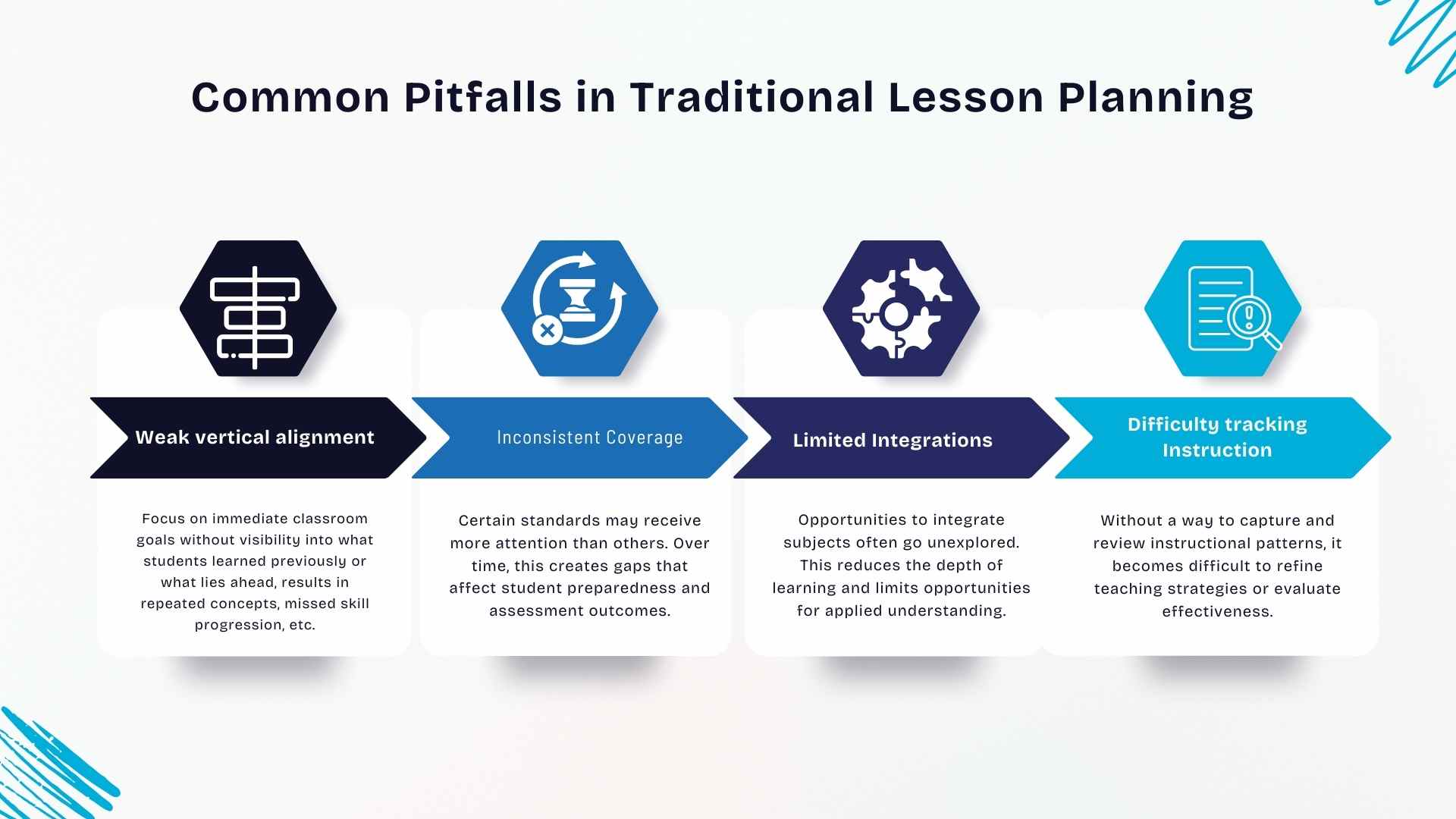
Lesson planning is essential for classroom instruction but it cannot, on its own, ensure system-wide alignment. Without a broader framework, even strong lesson plans can exist in isolation.
Weak vertical alignment across grades
Teachers often focus on immediate classroom goals without visibility into what students learned previously or what lies ahead. This results in repeated concepts, missed skill progression, and uneven learning pathways across grade levels.
Inconsistent standards coverage
Without structured curriculum management, certain standards may receive more attention than others. Over time, this creates gaps that affect student preparedness and assessment outcomes.
Limited interdisciplinary connections
Opportunities to integrate subjects such as literacy within science or numeracy within social studies, often go unexplored. This reduces the depth of learning and limits opportunities for applied understanding.
Difficulty tracking planned vs delivered instruction
Lesson plans outline intent. But actual classroom delivery may vary. Without a way to capture and review instructional patterns, it becomes difficult to refine teaching strategies or evaluate effectiveness.
Lesson planning is powerful at the classroom level. Curriculum mapping extends that power across the school.
What Is Curriculum Mapping and Why It Matters Now
Curriculum mapping is the structured process of documenting what is taught, when it is taught and how it aligns with standards, assessments and long-term learning goals. For school leaders, it provides something that traditional curriculum planning often lacks, i.e., visibility. It allows administrators to understand instructional patterns across grades, track curriculum coverage and ensure alignment between lesson plans, learning outcomes and assessments.
At a time when schools must demonstrate both consistency and impact, curriculum mapping becomes a leadership tool, not just an academic process.
How Curriculum Mapping Solves Core Curriculum Planning Challenges
For many schools, curriculum planning challenges don’t appear overnight; they build gradually. A missed standard here, duplicated content there, inconsistent pacing across grades or gaps discovered only during assessments or accreditation reviews. By the time leaders notice the patterns, they’re often reacting rather than proactively guiding instruction.
This is where curriculum mapping changes the equation. Instead of relying on scattered lesson plans and retrospective fixes, schools gain a structured, system-wide view of teaching and learning. Instruction becomes visible, alignment becomes measurable and curriculum management becomes intentional rather than operational.
When curriculum mapping is embedded into a school’s curriculum management strategy, curriculum planning shifts from fragmented documentation to coordinated academic design. School leaders move from asking “What is being taught?” to confidently answer “How does our curriculum progress, align and support student outcomes?”
Here’s how curriculum mapping directly addresses the most persistent curriculum planning challenges schools face:
- Creates clarity across classrooms and grades: Curriculum mapping centralizes lesson plans, units and standards into one structured view. Leaders can see how instruction unfolds across the academic year. This helps identify overlaps, gaps and progression issues without relying on manual audits.
Here’s an interesting insight. While popular virtual learning tool, Google Classroom, remains one of the most popular AI tools in the primary grades with 80% educators opting for it, automated grading tools like ZipGrade and Turnitin continue to have limited adaptability in the primary grades.
- Strengthens alignment with standards and outcomes: Mapping connects instruction directly to learning goals and competencies. This ensures that curriculum planning remains purposeful and aligned with long-term student development.
- Improves consistency in curriculum management: Updates can be implemented systematically across departments rather than individually. This protects instructional continuity and reduces dependency on individual teachers.
- Encourages collaboration among educators: Teachers gain visibility into shared lesson plans and curriculum priorities. This supports peer learning, reduces duplication and fosters collective ownership of instructional quality.
- Enables data-informed academic decisions: Leaders can analyze coverage, pacing and alignment trends across subjects. These insights guide professional development, resource allocation and curriculum improvements.
- Simplifies reporting and accreditation: Curriculum documentation, alignment records and instructional evidence are readily available. This reduces administrative burden and strengthens confidence during reviews.
Curriculum mapping doesn’t replace lesson planning. It gives it purpose, direction and continuity. Instead of existing as isolated classroom efforts, lesson plans become part of a coherent, school-wide instructional pathway. Teachers gain clarity, leaders gain visibility and curriculum planning evolves from a series of individual actions into a shared academic strategy that consistently supports student learning.
The Role of Technology in Modern Curriculum Management
As curriculum demands grow, manual mapping approaches become difficult to sustain. Digital tools allow schools to manage curriculum dynamically rather than statically. AI-powered curriculum platforms now support:
- Continuous curriculum updates: Changes to standards or priorities can be reflected across mapped curriculum structures instantly. This prevents outdated materials from circulating and ensures consistency.
- Automated alignment insights: AI can detect gaps, redundancies and pacing inconsistencies across lesson plans. This allows leaders to intervene early rather than respond after outcomes decline.
- Institutional knowledge continuity: Curriculum artifacts remain accessible regardless of staffing changes. This protects instructional continuity and reduces rework.
- Leadership-level visibility: Dashboards and reports provide a clear picture of curriculum implementation and progress. This enables more strategic planning and informed decision-making.
Modern curriculum mapping software like Edusfere represent this shift, helping schools move from fragmented curriculum planning to structured, insight-driven curriculum management.
Building a Culture of Intentional Curriculum Planning
While technology simplifies change, it takes a culture shift to sustain it. Schools that have successfully implemented the curriculum mapping as a culture, often treat it as a collaborative process.
- Shared instructional priorities: School leaders and teachers co-create curriculum goals, ensuring clarity and ownership. This increases adoption and strengthens alignment.
- Reflective lesson planning practices: Lesson plans are reviewed for alignment and impact, not just completion. This improves teaching quality and encourages continuous learning.
- Structured review cycles: Curriculum is revisited regularly to remain relevant and responsive to student needs. This prevents stagnation and supports innovation.
- Ongoing teacher support: Professional development equips educators to interpret curriculum insights and refine instruction. And empowered teachers are more likely to drive sustainable change.
What School Leaders Should Look for in a Curriculum Mapping Approach
By the time most schools decide to invest in curriculum mapping, they’ve already felt the strain in the form of misaligned lesson plans, inconsistent pacing, accreditation stress or limited visibility across grades. But the reality is not all curriculum mapping approaches deliver long-term impact.
Some schools adopt tools that become digital filing cabinets. Others implement processes that feel like additional compliance work rather than instructional support. Within a year, adoption drops and curriculum planning slips back into silos.
Choosing the right curriculum mapping approach is not just a technical decision. It’s a strategic leadership decision. The system you select will influence teacher collaboration, curriculum management efficiency and instructional coherence for years to come.
To ensure sustainable success, school leaders should evaluate the following:
- Teacher-friendly workflows: Curriculum mapping must integrate into lesson planning, not add administrative complexity. Ease of use drives adoption.
- Alignment-first design: The system should connect standards, assessments and instruction seamlessly. This ensures curriculum planning translates into measurable learning outcomes.
- School-wide scalability: The approach should work across grades and subjects, not in isolated pockets. Consistency strengthens curriculum management.
- Actionable insights, not just documentation: Leaders need data that informs decisions, not just records activity. Insight-driven planning leads to stronger outcomes.
Curriculum management tools like Edusfere are built with these priorities, supporting schools in managing curriculum strategically while strengthening everyday lesson planning.
Meanwhile, here’s what Carly Zarate from New Life Christian School, Maryland had to say about Edusfere’s ease of use in terms of lesson planning.
“It is helpful to have it all organized with the parts of the lesson and the materials needed. The website is very easy to use. I didn’t have any problems navigating through it.”
FAQs about Curriculum Mapping, Curriculum Planning and Lesson Planning
- What is curriculum mapping in education?
Curriculum mapping is the process of documenting instruction across grades, subjects and timelines to ensure alignment with standards, learning goals and assessments. It provides leaders and teachers with a clear, school-wide view of curriculum delivery.
- How does curriculum mapping improve curriculum planning?
It connects lesson planning to long-term learning outcomes and standards. This ensures consistency, reduces gaps and supports intentional curriculum management across the school.
- What is the difference between curriculum mapping and lesson planning?
Lesson planning focuses on classroom instruction. Curriculum mapping connects those plans across grades and subjects, ensuring alignment and progression.
- Why is curriculum management important for schools?
Effective curriculum management ensures consistent instruction, protects institutional knowledge, supports collaboration and strengthens accountability.
- How does curriculum mapping support teachers?
It gives teachers visibility into prior and upcoming learning, helping them design better lesson plans and avoid repetition.
- How often should curriculum maps be reviewed?
Most schools review them annually with ongoing updates throughout the year to remain aligned with student needs and standards.
- Can AI improve curriculum planning?
AI can analyze coverage, detect gaps, generate alignment insights and simplify reporting, saving time and supporting better decision-making.
- Who should be involved in curriculum mapping?
School leaders, curriculum coordinators, teachers and instructional coaches should collaborate to ensure alignment and adoption.
- What should schools look for in curriculum mapping software?
Ease of use, standards alignment, lesson planning integration, collaboration tools and reporting capabilities are critical.
- How can schools get started with curriculum mapping?
Begin by auditing current lesson plans and curriculum documents, identifying gaps and adopting a centralized platform that supports structured curriculum management and alignment.
From Curriculum Planning to Curriculum Leadership: Bringing structure, visibility and alignment to curriculum planning
Curriculum mapping enables a shift in mindset. Leaders move from managing documents to shaping instructional direction. Teachers move from working in isolation to collaborating with clarity. And schools move from compliance-driven planning to purpose-driven learning. This is where curriculum planning becomes curriculum leadership.
If your school is navigating fragmented lesson plans, inconsistent coverage or time-intensive documentation, it may be time to rethink how curriculum planning is managed. Edusfere helps K-12 schools transition from isolated planning to structured curriculum mapping and intelligent curriculum management by centralizing lesson plans, aligning standards and providing actionable insights for leaders.
Explore how Edusfere can support your school in building a more aligned, collaborative and future-ready approach to curriculum planning.