

Key Takeaways
- Title II-A funds people and practice, not materials or curriculum purchases.
- ESSA disqualifies one-off workshops. Funded professional development must be sustained, job-embedded and classroom-focused.
- Supplement-not-supplant is the compliance rule that trips up the most districts.
- The real return on Title II dollars shows up in instructional improvement, not attendance sheets.
- A documented link between professional learning and curriculum implementation is what audit reviewers and instructional leaders both want to see.
Our Title Funds guide for K-12 schools covers the compliance basics that apply across ESEA titles. This piece goes deeper on Title II specifically, i.e. what it funds, how to spend it well and how to connect professional learning to what actually changes in classrooms.
What Title II, Part A actually funds
Title II, Part A is a formula grant. Nearly every district receives an allocation and the money is meant for one purpose, i.e. improving the people who teach and lead schools, not the materials they teach with. Allowable uses include instructional coaching, teacher onboarding, leadership development, recruitment and retention incentives, class-size reduction and stipends or substitute coverage that make training possible during the school day.
For instance, NYC Public Schools, New York, NY district uses Title II-A funds to address:
- strategic staffing and school design;
- class size reduction, i.e., to decrease pupil-teacher ratio;
- teacher and leadership retention; and
- expanded graduate partnerships
What it doesn't fund is just as important. Curriculum purchases, instructional software licenses and general operating costs fall outside Title II-A's scope unless they're a minor, incidental part of a professional learning activity. School leaders who try to stretch Title II dollars to cover curriculum materials are usually looking at the wrong funding source; that's a Title I or Title IV conversation, not Title II.
Allowable Vs. Not Allowable: A Quick Reference
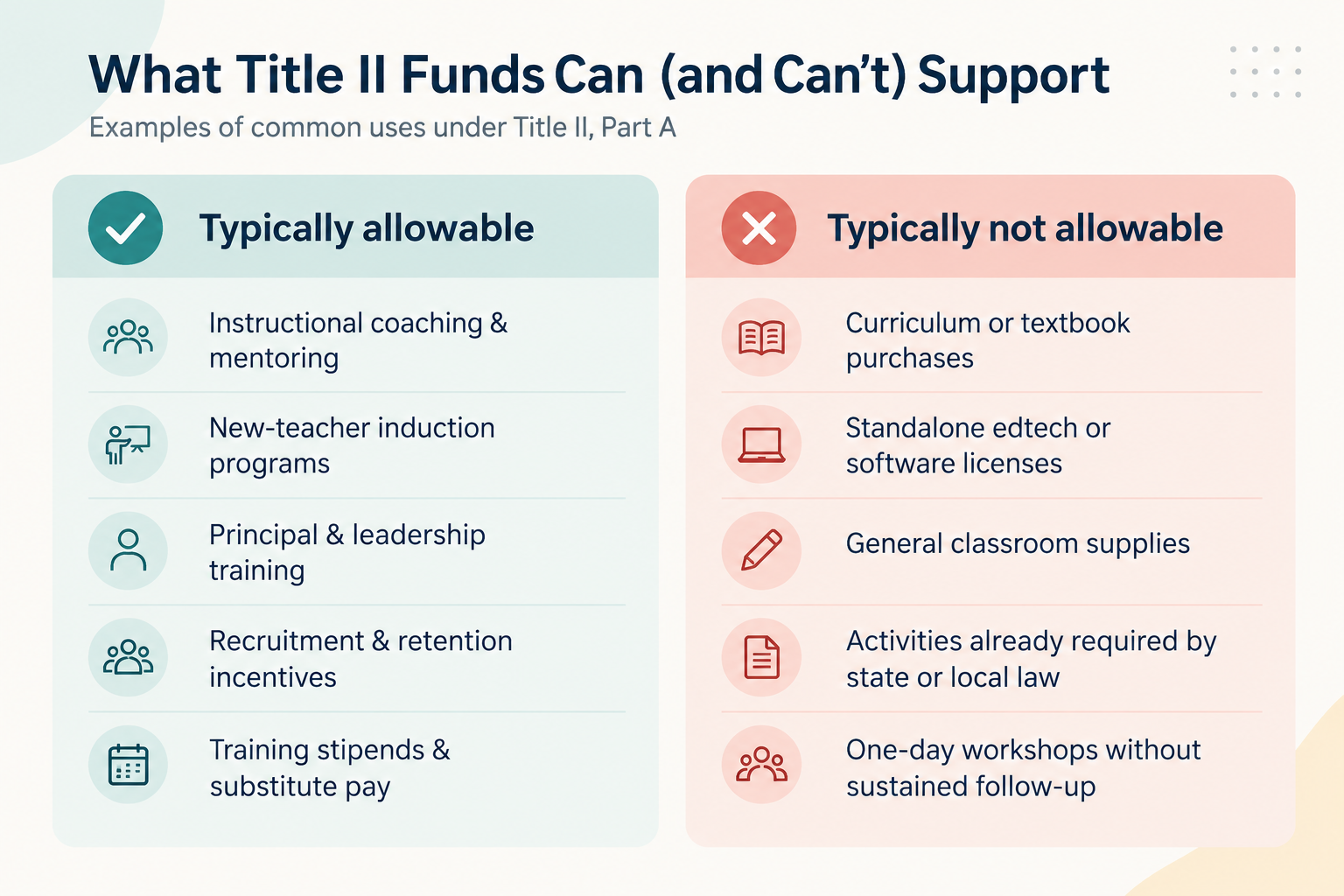
(Note: Treat this as a starting checklist, not a final answer. Confirm specific expenses against current state guidance before budgeting them.)
What Counts as Professional Development Under Title II-A
Not every training day qualifies for Title II-A funding. ESSA is specific. Funded professional development has to be sustained, intensive, collaborative, job-embedded, data-driven and classroom-focused. A single afternoon keynote with no follow-up doesn't meet that bar, even if it's well-run and well-received. This matters more than it sounds like it should because it reshapes how a school leader should plan professional learning in the first place.
Instead of booking a speaker for a back-to-school kickoff, sustainable Title II spending looks like a coaching cycle that runs across a semester, a peer-observation rotation tied to a specific instructional goal or an induction sequence that follows a new teacher through their first year. The unifying thread is a plan, not an event.
What is a PLC in Education?
PLC stands for Professional Learning Community. In education, a PLC is a team of teachers, usually grouped by grade level or subject, who meet on a recurring schedule to look at student work, plan instruction together and refine teaching based on the data. A PLC isn't a single meeting. It's an ongoing structure, which is why it fits the ESSA professional development definition so well. Sustained, collaborative, job-embedded and data-driven describe a functioning PLC just as well as they describe federal compliance language.
PLCs work best around a common curriculum, the same units, pacing and assessments so the team is comparing real differences in student results, not disconnected lesson plans. Title II-A can fund the parts that cost money including stipends for extended team time, substitute coverage for release periods and coaching to keep meetings focused on instruction rather than logistics.
Turning Title II Dollars into Instructional Improvement
Compliance keeps the funding intact. Instructional improvement is why the funding exists. Here's how to do both at once:
Start with a needs assessment, not a wish list
Before committing Title II dollars, tie the spending to a documented need, for e.g., a gap in observation data, a new curriculum rollout that requires training or a state standards shift. This isn't just good practice. A needs assessment is often the first thing a monitoring reviewer asks to see and it's the anchor for everything that follows.
In practice, that can be a one-page summary consisting of what the data showed, what practice the district wants to change and how the planned coaching addresses that gap. A district piloting a new math curriculum might point to walkthrough data showing inconsistent use of the pacing guide as the need and a semester-long coaching cycle on pacing and formative checks as the response.
Choose sustained models over one-off events
Coaching cycles, structured peer observation, multi-session induction programs and PLC cycles built around a common curriculum - all satisfy the ESSA professional development definition and tend to produce better outcomes than single-day workshops. If a vendor pitches a one-time session, ask what the follow-up looks like before committing funds.
Document the supplement-not-supplant test before you spend
Ask two questions for every planned expense. Is this legally required under state or local law? Did state or local funds cover this same activity last year?
If either answer is yes, Title II-A likely can't pay for it as the district has to spend its own funds first. A short written rationale for each major expense, kept at the time of the decision, protects the district later.
4. Connect professional learning to curriculum implementation
This is the step most districts skip. A coaching cycle on formative assessment is only as good as what happens to that learning afterward. Does it change how a unit gets taught, how a lesson gets planned, how a team documents its instructional decisions?
Building that connection explicitly, rather than assuming it happens on its own, is what separates professional learning that shows up in classrooms from professional learning that shows up only in a budget line.
Curriculum mapping is the practical mechanism for this. When a district keeps a live curriculum map, the units, pacing and standards alignment every teacher is actually working from; a coaching cycle's outcome can be recorded right where it's used. For instance, an updated unit note, a revised pacing decision, a new formative check built into the map itself. Without that map, the same insight tends to live in a coach's notebook instead of the classroom.
5. Build the audit trail as you spend, not after
Attendance records, coaching logs and a clear line from each expense to the needs assessment should exist in real time. Reconstructing them after a monitoring visit is scheduled is where districts lose credibility.
5 Common Title II-A Compliance Mistakes to Avoid
Most compliance findings trace back to a handful of avoidable patterns. Watch for these before a monitoring visit, not during one:
Stand-alone, one-day professional development with no sustained follow-up
Spending that duplicates a state- or district-mandated training already funded through other sources
No documented needs assessment connecting the expense to a specific goal
Missing attendance or participation records for stipended activities
Skipped or undocumented equitable-services consultation with eligible private schools
Title II vs. Title I: A Quick Distinction
Title I follows students; specifically, funding tied to concentrations of low-income students. Title II follows educators, funding the professional development, coaching and leadership training meant to improve instruction for everyone those students encounter. The two titles often work together in a school improvement plan.
A Title I school might fund extended learning time or intervention staff, while Title II funds the coaching that helps teachers deliver that intervention well. They answer different questions on a budget worksheet, though and reviewers expect districts to keep that line clear rather than blending the two.
Frequently Asked Questions (FAQs)
What does PLC stand for in education?
PLC stands for Professional Learning Community, a recurring team of teachers who examine student data and refine instruction together, usually around a common curriculum. It's an ongoing structure, not a one-time meeting.
Does Title II-A pay for PLC time?
Yes, generally. Stipends, substitute coverage for release time and coaching or facilitation support for PLC meetings match the ESSA professional development definition, so they're typically allowable.
Can Title II-A funds pay for curriculum materials?
No. Title II-A is restricted to activities that build educator capacity like coaching, training, mentoring, leadership development. Curriculum purchases fall under different funding streams.
How much Title II-A funding does a district receive and does it change year to year?
It varies by state and district size, since it's a formula grant based on student population and poverty data. Appropriations are set annually, so treat any figure as a planning estimate until the state confirms it.
What's the biggest reason districts run into trouble on a Title II-A review?
Supplement-not-supplant issues and undocumented, one-off professional development are the most common findings.
Does Title II-A require tracking instructional outcomes, not just attendance?
Federal guidance requires PD to meet the sustained, job-embedded definition and connect to a needs assessment. It doesn't mandate a specific tracking method, which is why documentation practices vary by district.
The bigger picture
Title II-A compliance is a paperwork discipline. Instructional improvement is a documentation discipline that continues long after the professional learning session ends. The districts that get the most value from Title II funding can trace a straight line from a coaching cycle or PLC to a change in how a lesson gets planned; not just a line from an invoice to a budget code.
That habit pays off twice. It satisfies a monitoring reviewer and it answers an instructional leader's real question, i.e., did a semester of coaching actually change what happens in classrooms?
Curriculum management software like Edusfere keeps lesson planning and curriculum documentation in one place, which makes that line easier to see. But the underlying discipline involved in planning the learning, documenting the spend and following it into the classroom, holds regardless of what system a district uses.
For a closer look at how modern curriculum management tools like Edusfere support standards alignment and accreditation readiness through curriculum mapping, take a quick look at our advanced AI-backed features.
Further Reading and Resources:
- Using Title I and II Funds to Support School Design that Boosts Student Learning
- Bipartisan Policy Center (FY2026)
- Washington OSPI, New Jersey DOE
- Other state Title II-A guidance
- https://edusfere.com/how-does-edusfere-handle-k-12-curriculum-management-a-feature-by-feature-breakdo/
- https://edusfere.com/what-is-a-plc-in-education-a-complete-guide-to-professional-learning-communities-how-they-empower-teachers/
- https://edusfere.com/what-is-a-plc-in-education-a-complete-guide-to-professional-learning-communities-how-they-empower-teachers/