
Key Takeaways
- Are your standards and worldview telling the same story?
- Can your curriculum map show more than coverage?
- What happens when curriculum mapping meets lesson planning?
- Is your curriculum documentation connected or scattered?
- What should modern curriculum mapping software actually connect?
For ACSI schools, curriculum planning has to achieve more than academic coverage. Schools also need to show how learning reflects their biblical worldview. That can become difficult when standards, curriculum maps, lesson plans, resources and assessments are kept in separate places. Leaders may know that the pieces are there but connecting them across grades and subjects can take time.
A strong curriculum mapping process can bring those pieces together. It can help schools align state standards with curriculum goals. Additionally, it also enables documenting meaningful biblical integration and connecting curriculum decisions to daily lesson planning.
Why Does Curriculum Mapping Matter for ACSI Schools?
Curriculum mapping gives school leaders a school-wide view of what students are expected to learn, when they encounter it and how learning is assessed. It also helps teachers understand how their lessons fit into the larger curriculum. This is particularly useful when academic standards and biblical worldview are both central to curriculum design. The goal is not to create two separate systems. It is to make the relationship between them visible.
ACSI supports more than 25,000 schools across 108 countries and approximately 2,200 U.S. member schools, serving students from preschool through Grade 12.
For school leaders, the question is therefore not simply whether standards and biblical integration appear somewhere in the curriculum. The bigger question is whether the leaders can demonstrate that alignment consistently in reports.
How Can Christian Schools Align Curriculum With State Standards?
State standards define the academic expectations students are expected to meet. Curriculum mapping connects those expectations to the actual learning experiences students receive. A well-designed curriculum map can show where standards are addressed and how they progress through a course or grade level. It can also help leaders identify gaps, unnecessary repetition, and standards that receive limited attention. For example, a curriculum map might connect:
- State standards
- Course and unit objectives
- Learning experiences
- Instructional resources
- Assessments
- Expected student outcomes
This creates a clearer record of curriculum coverage. It also gives teachers a stronger starting point when they plan instruction. For ACSI schools, however, academic alignment is only one part of the picture.
How Do ACSI Schools Document Biblical Worldview Integration?
Biblical worldview integration should be more than a statement in a curriculum handbook. It should be visible in appropriate learning experiences and documented in a way that teachers and leaders can understand. That does not mean adding a biblical reference to every lesson. Meaningful integration depends on the subject, learning objective, age group and instructional context.
Consider a science unit on ecosystems. Students may study food webs, energy flow and environmental change. The same unit could also create an appropriate opportunity to explore stewardship and humanity's responsibility toward creation. The important point is that the connection should be intentional and relevant to the learning.
A curriculum map can make that connection easier to document by showing the relationship between the academic objective, the learning experience and the relevant worldview perspective.
Mapping Standards and Biblical Worldview Together
For ACSI schools, curriculum mapping can make academic standards and biblical worldview integration visible in the same planning structure.
For example, a Grade 7 science unit on ecosystems might include:
Academic standard: NGSS MS-LS2, focusing on relationships among organisms and ecosystems
Learning objective: Students explain how changes to one population can affect other organisms in an ecosystem
Essential question: How are organisms within an ecosystem interdependent?
Biblical worldview theme: Creation and stewardship
Worldview question: What responsibilities accompany humanity’s ability to affect an ecosystem?
Learning activity: Analyze the impact of pollution or habitat change on a local ecosystem
Assessment: Build an ecosystem model and use scientific evidence to recommend a response to an environmental issue
The important point is that the academic standard remains intact. Biblical integration does not replace the science requirement; it adds a structured worldview dimension to how students explore and apply the subject. A connected curriculum map can also help school leaders see where both elements appear across grades. Instead of maintaining standards, biblical integration and lesson plans in separate spreadsheets, schools can potentially trace:
Academic Standard → Curriculum Unit → Biblical Worldview Concept → Lesson Plan → Assessment Evidence
This can also make gaps easier to identify. For example, units that are aligned to academic standards but do not yet contain documented biblical integration or places where a theme such as stewardship should develop progressively from elementary through high school. For ACSI schools, this turns biblical integration from a general curriculum intention into something that can be planned, reviewed and evidenced across the curriculum.
How Does Curriculum Mapping Connect Standards, Instruction And Biblical Integration?
The strongest curriculum maps do more than list standards. They connect different layers of curriculum planning. A school might document a unit like this:
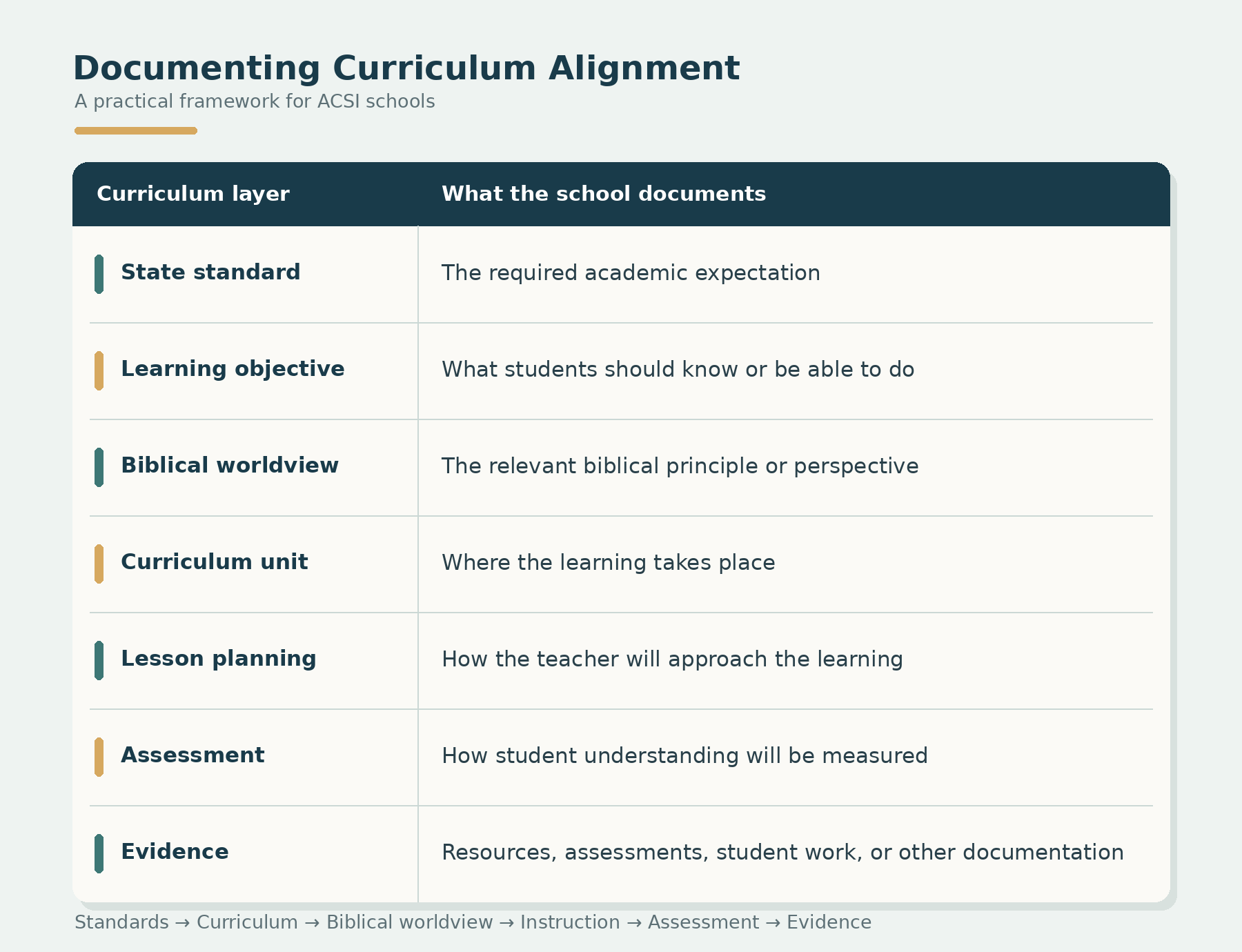
This creates a more complete picture of curriculum alignment. Instead of asking only whether a standard is covered, leaders can ask:
How is this standard taught, reinforced, assessed and connected to the school's educational mission?
That is a much more useful curriculum management question.
Why is Curriculum Management Difficult Across Multiple Grades and Subjects?
Curriculum alignment becomes harder as schools grow. More teachers mean more courses, lesson plans, resources and decisions about what belongs where. The problem is often not a lack of information. It is the lack of a connected system for managing that information.
Standards may sit in spreadsheets. Curriculum maps may exist as separate documents. Lesson plans may be stored elsewhere. Resources may live in shared drives or individual teacher folders. This fragmentation can create several challenges:
- Curriculum maps become difficult to maintain.
- Teachers may repeat planning work.
- Standards coverage becomes harder to review.
- Biblical integration can vary between classrooms.
- New teachers have less curriculum context.
- Leaders spend more time gathering documentation.
Effective curriculum management should reduce this fragmentation. It should give teachers and leaders access to the information they need without requiring them to search across multiple systems.
How Much Time Do Teachers Have for Lesson Planning?
Teacher time is an important part of this discussion. Even a well-designed curriculum is difficult to use if teachers have to spend excessive time finding information before they can plan a lesson.
The OECD's Education at a Glance 2026 reports that lower-secondary teachers spend an average of 14% of their total working time on lesson planning. Lesson planning is the second-largest reported use of teachers' working time after teaching.
A 2025 analysis by the National Council on Teacher Quality also found that about one-third of districts in its sample provided roughly 3.5 to 4 hours of teacher planning time per week. The implication is simple. Lesson planning time needs to be supported by useful curriculum context. When teachers can see the relevant standards, unit goals, resources and expectations while planning, they can spend more of that time on instructional decisions.
What Should Modern Curriculum Mapping Software Help Schools Manage?
Modern curriculum mapping software should do more than replace a spreadsheet. It should connect the information teachers and school leaders already use.
A strong platform should help schools manage:
- Standards alignment: Connect standards to courses, units, objectives and learning experiences.
- Curriculum mapping: Show what is taught, where it is taught and how learning progresses.
- Lesson planning: Give teachers access to relevant curriculum context as they plan instruction.
- Teacher Resources: Keep teaching materials connected to the curriculum where they are used.
- Assessment: Connect assessments to learning objectives and standards.
- Biblical integration: Provide a consistent place to document meaningful worldview connections.
- Reporting: Help leaders review curriculum coverage and identify gaps or overlaps.
The value comes from these connections. A curriculum map that does not inform instruction remains a static document. A lesson-planning tool with no connection to the wider curriculum creates another silo.
How Does Lesson Planning Fit Into Curriculum Management?
Curriculum mapping and lesson planning serve different purposes, but they work best when they are connected. A curriculum map provides a broader view. It establishes what students should learn and how learning progresses.
A lesson plan operates at the classroom level. It translates those goals into specific instructional decisions.
When the two are connected, teachers do not have to start from a blank page. They can plan within the context already established by the school.
This also gives leaders better visibility. They can see how classroom instruction relates to the intended curriculum without creating unnecessary layers of documentation.
How Can ACSI Schools Create A More Connected Curriculum Documentation Process?
Schools do not need to redesign their entire curriculum process at once. A practical approach is to connect the information they already have.
Identify the required standards: Establish which state standards apply to each grade, subject or course.
Map standards to curriculum: Connect standards to units, learning objectives and expected outcomes.
Identify meaningful worldview connections: Document where biblical principles or perspectives naturally support the learning.
Connect curriculum maps to lesson planning: Give teachers the context they need when planning individual lessons.
Connect assessments and evidence: Show how students demonstrate the knowledge and skills identified in the curriculum.
Review curriculum across the school: Use curriculum management tools to identify gaps, repetition and inconsistencies.
Keep documentation active: Update curriculum information as standards, resources and instructional practices change.
The goal is not to create more paperwork. It is to make existing curriculum information more useful.
How Can Edusfere Support Curriculum Mapping and Lesson Planning?
Edusfere brings curriculum mapping, curriculum management, standards alignment and lesson planning into a connected environment. For ACSI schools, this can provide a more structured way to manage the relationship between academic expectations and the school's educational mission.
As ACSI's official curriculum mapping partner, Edusfere helps schools connect these elements in one environment.
Teachers can plan within established curriculum maps rather than working in isolation. School leaders can review curriculum across subjects and grades. Standards can remain connected to instruction instead of becoming static reference documents.
Schools can also document biblical worldview connections within their curriculum framework. The school defines what meaningful integration looks like. Edusfere provides the structure for managing and reviewing that information.
The result is a curriculum record that is easier to maintain, review and use.
Frequently Asked Questions About Curriculum Mapping for ACSI Schools
How do ACSI schools align curriculum with state standards?
ACSI schools can use curriculum mapping to connect state standards with courses, units, learning objectives, instruction and assessment. This creates a clear record of where standards are addressed and how students are expected to demonstrate learning.
How can Christian schools document biblical worldview integration?
Schools can document biblical worldview integration within curriculum units, learning objectives, instructional plans and relevant assessments. The strongest approach focuses on meaningful connections to the subject rather than adding superficial references to individual lessons.
What is the difference between curriculum mapping and lesson planning?
Curriculum mapping provides a broader view of what students should learn and how learning progresses. Lesson planning focuses on how teachers will deliver that learning in a specific classroom context. Connecting the two helps teachers plan within the wider curriculum.
How does curriculum management software help school leaders?
Curriculum management software gives leaders a central view of curriculum information across grades and subjects. It can help them review standards alignment, curriculum coverage, lesson planning, resources, assessments and other evidence.
What should schools look for in modern curriculum mapping software?
Schools should look for software that connects curriculum mapping with standards alignment, lesson planning, resources, assessment and reporting. Ease of use is also important because the system needs to work for both teachers and school leaders.
Building a curriculum that is aligned, connected and visible
For ACSI schools, academic standards and biblical worldview do not need to exist as separate layers of curriculum documentation. The stronger approach is to connect them.
Curriculum mapping shows where standards and learning objectives fit. Curriculum management keeps that information organized and current. Lesson planning brings the curriculum into daily instruction. Modern curriculum mapping software can help keep these pieces connected.
When curriculum information is visible and connected, school leaders gain a clearer view of what is being taught. Teachers gain better context for planning. Schools also have stronger documentation of how academic expectations and their educational mission work together.
The goal is not more documentation. It is a curriculum that is aligned, intentional and easier to see across the entire school.