

Summative assessment versus formative assessment differ in timing, purpose and feedback style. Formative assessments are ongoing, student-centred tools that guide learning in real time, while summative assessments evaluate mastery at the end of instruction. Together, they create a balanced, data-driven approach to improving student outcomes in K-12 education.
What’s inside this blog:
- What is Summative Assessment?
- What is Formative Assessment?
- Why understanding both is necessary in K-12 Education
- 8 Key Differences Between Summative and Formative Assessment
- Integrating Formative and Summative Assessment in Practice
- How to make assessments more Student-centered
- FAQs: Formative vs. Summative Assessment in K-12 Classrooms
- Building a student-centered classroom through Balanced Assessment
Learning is becoming increasingly student-centred in modern day classrooms and the role of assessment has evolved far beyond grading. Educators are expected not just to measure achievement but to nurture growth, engagement and self-reflection. That’s why understanding the core differences between summative assessment versus formative assessment is essential for K-12 teachers and school leaders alike.
While both the assessment formats are valuable, they serve very different purposes. Summative assessments measure what students have learned. On the other hand, formative assessments guide how they learn. When used together strategically, they create a balanced ecosystem where students can reflect, revise and reach mastery.
Today’s blog breaks down everything educators need to know about summative and formative assessments including definitions, purposes, key differences and best practices so you can design a truly student-centred, data-informed classroom.
What is Summative Assessment?
Summative assessment is the evaluation of student learning at the end of an instructional unit, term or course. It’s often high-stakes, providing a summary of achievement that can determine advancement, placement or grades.
Examples include:
- End-of-term exams or benchmark tests
- Standardized state assessments
- Final projects or capstone presentations
- District-level common assessments
The goal of summative assessment is to measure what students know and can do after instruction. It’s an assessment of learning through reflecting upon the cumulative understanding that has taken place.
In the US K-12 context, summative assessments are critical for accountability, curriculum evaluation and policy decisions. But when overemphasized, they risk reducing learning to test scores rather than reflection, inquiry and growth.
What is Formative Assessment?
Formative assessment is the process of continuously checking for understanding throughout instruction. It’s low-stakes, flexible and focused on helping students and teachers make adjustments in real time.
Examples include:
- Exit tickets or quick reflections
- Think-pair-share discussions
- Observation notes
- Peer and self-assessment
- Ongoing feedback on drafts
Formative assessment is assessment for learning. It empowers students to become active participants by reflecting, setting goals and adjusting their learning strategies based on feedback. For teachers, it’s a way to adapt instruction dynamically. For students, it’s a mirror for their own progress, one that makes learning visible and actionable.
Why understanding both is necessary in K-12 Education
In a student-centered learning environment, assessment is not a one-time judgment; it’s an ongoing dialogue between teacher and learner.
Formative and summative assessments complement each other. One guides the journey, the other validates the destination. By understanding and balancing both, educators can:
- Personalize instruction for diverse learners
- Reduce test anxiety and increase engagement
- Create equitable grading systems
- Use data to inform intervention and enrichment
- Align curriculum, instruction and evaluation
When K-12 schools design systems that value both formative and summative feedback, learning becomes holistic, inclusive and meaningful. That is precisely what student-centered education aspires to achieve.
8 Key Differences Between Summative and Formative Assessment
- Timing and Frequency
Formative assessment occurs continuously, during lessons, discussions or activities. It helps teachers and students make immediate adjustments. Summative assessment happens periodically, typically at the end of a unit or semester. Here’s a sneak peek at how both work:
Formative: Ongoing learning checkpoints
Summative: End-point evaluation
Frequent formative assessment helps learners see progress and teachers intervene early. Summative assessments validate what has been learned across a longer arc.
- Purpose and Intent
Formative assessments are diagnostic and developmental, helping to identify learning gaps. Summative assessments are evaluative, confirming mastery of content.
Formative: “How are we doing?”
Summative: “How did we do?”
Both purposes are essential, but educators should ensure students understand why they are being assessed, it builds transparency and trust.
- Stakes and grading
Formative assessments are low-stakes or ungraded, emphasizing feedback. Summative assessments are high-stakes, often linked to grades, promotion or accountability metrics.
Balanced grading systems that value growth (formative data) as well as mastery (summative results) align best with student-centered philosophies.
- Feedback and responsiveness
Formative assessments generate immediate, actionable feedback as students can revise, retry and reflect. Summative assessments typically provide delayed, final feedback that informs future instruction but doesn’t affect current learning. In student-centered classrooms, timely feedback transforms mistakes into opportunities for improvement rather than causes for discouragement.
- Student involvement and agency
Formative assessment encourages student voice and choice through peer reviews, goal setting and reflection. Summative assessment tends to be teacher-driven.
When learners participate in assessment, they internalize success criteria, develop metacognition and become partners in learning rather than passive participants.
- Focus on Process vs. Product
K-12 educators are increasingly encouraged to highlight process evidence (journals, portfolios, progress checks) alongside summative products. This shift aligns with whole-child learning frameworks.
Formative: Process-oriented, valuing growth over time.
Summative: Product-oriented, valuing outcomes and results.
- Instructional Impact
Formative assessments inform day-to-day instructional decisions encompassing what to reteach, when to differentiate, how to pace lessons. Summative data informs long-term planning and policy, such as curriculum mapping or school improvement plans.
Effective schools use both; formative data for classroom agility, summative data for systemic insight.
- Role in Learning Culture
Formative assessment fosters a growth mindset culture, where mistakes are part of learning. Summative assessment often reflects a performance mindset, emphasizing results. Balancing both ensures students experience achievement as a journey, not a verdict. The classroom becomes a space for curiosity, feedback and celebration of progress.
Integrating Formative and Summative Assessment in Practice
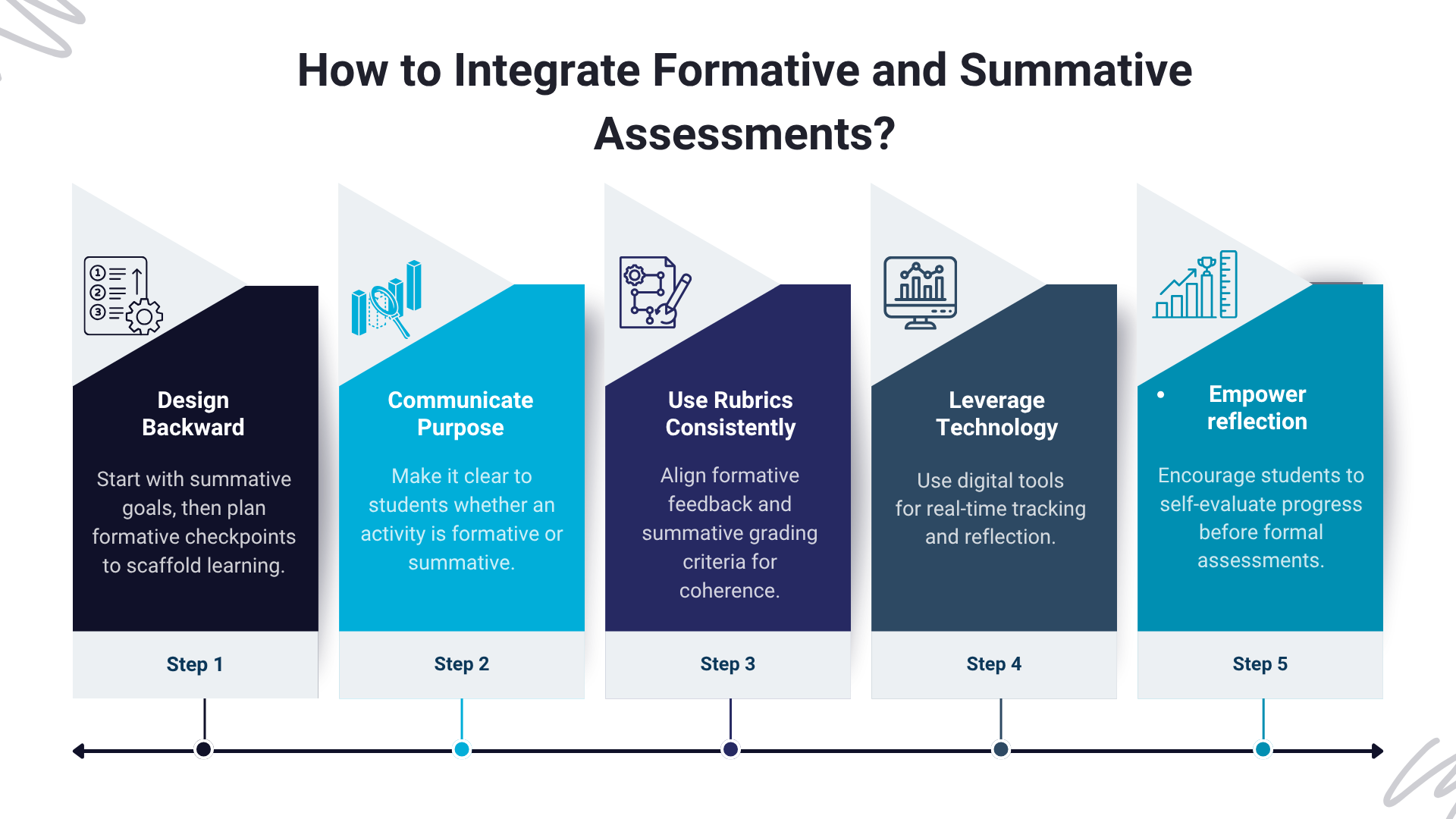
For educators and school leaders, the goal is not to choose one over the other but to connect the two intentionally. Here’s how:
- Design backward: Start with summative goals, then plan formative checkpoints to scaffold learning.
- Communicate purpose: Make it clear to students whether an activity is formative or summative.
- Use rubrics consistently: Align formative feedback and summative grading criteria for coherence.
- Leverage technology: Use digital tools (like Edusfere’s curriculum and assessment platform) for real-time tracking and reflection.
- Empower reflection: Encourage students to self-evaluate progress before formal assessments.
When implemented strategically, formative data feeds directly into summative success and both become learning tools rather than administrative tasks.
How to make assessments more Student-centered
To make assessments align with student-centered values, educators can:
- Co-create success criteria with students
- Integrate reflection prompts after every activity
- Encourage peer feedback as a form of collaboration
- Use formative results to tailor future instruction
- Celebrate growth in addition to mastery
This approach transforms assessment from a measure of compliance into a measure of engagement, effort and evolution.
FAQs: Formative vs. Summative Assessment in K-12 Classrooms
Q1. Can one assessment serve both purposes?
Yes. For example, a project can start as a formative process (students receive feedback and revise) and end as a summative evaluation (final grade). The purpose depends on timing and intent.
Q2. Why is formative assessment considered more student-centred?
Because it positions students as active learners who use feedback, self-reflect and set learning goals. It’s participatory rather than judgmental.
Q3. Is summative assessment still important in a student-centered classroom?
Absolutely. Summative assessment validates learning outcomes and ensures accountability. The key is balance, not replacement.
Q4. How often should formative assessments be used?
Ideally, daily or weekly, woven naturally into classroom instruction through discussion, observation or digital tools.
Q5. How can school leaders support teachers in balancing both?
By creating assessment policies and professional development that promote formative practices, data-informed instruction and collaborative reflection rather than test-centric accountability.
Building a student-centered classroom through Balanced Assessment
Understanding the distinctions between summative assessment versus formative assessment is the cornerstone of a balanced, student-centered learning environment. When educators combine the diagnostic power of formative feedback with the evaluative strength of summative results, they create classrooms where students aren’t just tested; they’re transformed.
Formative assessments guide, summative assessments validate. And together, they create a complete picture of student growth. This balanced approach nurtures reflective learners, informed teachers and equitable systems.
At Edusfere, we help K-12 schools design assessment ecosystems that honour learner diversity and empower teachers through actionable data, curriculum alignment and student-centered tools that make learning measurable and meaningful.